November 2007 Edition
software industry insight
Looking through the crystal ball
Five years down the road: Here's what some predict
T&P asked a group of well-known
individuals in the software industry the following question:
What do you see as the biggest changes occurring in your software product in the
next five years and how will that enhance manufacturing?
Their crystal ball responses follow.
 |
| Comments
from Mark Summers, President, CNC Software, Inc.(Mastercam) |
Mastercam software will continue to get intuitively
smarter, more flexible, and remain open to add-ins. In the
area of automation, Mastercam will continue to combine the
front-end automation that helps programmers work quickly,
yet it will be unrestrictive. As users' skills grow, they
will be able to go even deeper into the software to gain
precise control over every aspect of tool motion. As such,
software will become increasingly flexible, with a unique
combination of intelligent automation and meticulous user
control with less interaction with menus and more
interaction directly with the model and the tool paths.
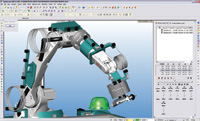 The
open architecture of Mastercam allows for a variety of
add-ins – utilities which increase its power and vice versa.
Within five years it will be even easier for outside
developers to integrate with Mastercam. Robotics and
computerized gaging are growth areas in manufacturing, and
we are partnering with many of these equipment builders now.
We're also developing future Mastercam versions to be more
closely tied to CAD products than they already are. We are
modularizing our programming so that Mastercam toolpaths are
readily available to run within CAD packages, and to
seamlessly open and program native CAD files. Further, we
continue to advance our tools, giving programmers the design
tools they need. CNC Software (Mastercam),
www.rsleads.com/711tp-154
The
open architecture of Mastercam allows for a variety of
add-ins – utilities which increase its power and vice versa.
Within five years it will be even easier for outside
developers to integrate with Mastercam. Robotics and
computerized gaging are growth areas in manufacturing, and
we are partnering with many of these equipment builders now.
We're also developing future Mastercam versions to be more
closely tied to CAD products than they already are. We are
modularizing our programming so that Mastercam toolpaths are
readily available to run within CAD packages, and to
seamlessly open and program native CAD files. Further, we
continue to advance our tools, giving programmers the design
tools they need. CNC Software (Mastercam),
www.rsleads.com/711tp-154
As users' skills grow, they will be able to go
even deeper into the software to gain precise control
over every aspect of tool motion. As such, software will
become increasingly flexible.
 |
| Comments
from John Cachat, Chairman and Founder, IQS |
The biggest change for the IQS quality-management
software in the next five years will be the creation of a
Global IQS Ecosystem and application of mobile devices. This
is the logical extension from just helping within a company
to extending out to customers and suppliers. Just as the
automotive industry pioneered electronic data interchange
(EDI) to streamline accounting and inventory transactions,
IQS R&D has been working on enabling several supply-chain
communications, including, but not limited to, engineering
changes, nonconformance reports, part submittals, corrective
action requests, et cetera. The fundamental driving force of
the ecosystem is that process-driven business improvement
cannot be optimized using non-integrated, stand-alone point
solutions. Therefore, enterprise applications like IQS are
required before we start the electronic communication (just
as ERP was needed for accounting and inventory transaction).
IQS leads the industry with its ability to support global
deployments with a single instance, multi-site,
multi-lingual framework. Two major forces drive the system:
cost reduction and information flow. The IQS Global
EcoSystem provides rapid information flow across the supply
chain using web services.
At IQS, we have optimized our clients' business
by centralizing and linking all data associated with
quality – from engineering to post production.
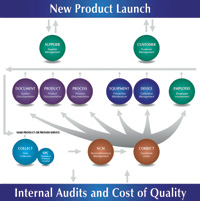 The
second area the IQS will be dedicating R&D efforts is toward
the application of mobile devices. IQS has been accepted
into Motorola PartnerSelect Program. Quality management is a
data-intensive process. At IQS, we have optimized our
clients' business by centralizing and linking all data
associated with quality – from engineering to post
production. Motorola's mobile offering takes our
streamlining to another level by accurately and reliably
capturing data right at the source. The combination of the
mobile data acquisition, and centralized, enterprise quality
management will provide tremendous value to manufacturers
focusing on efficiency. This R&D effort with Motorola will
allow IQS to:
The
second area the IQS will be dedicating R&D efforts is toward
the application of mobile devices. IQS has been accepted
into Motorola PartnerSelect Program. Quality management is a
data-intensive process. At IQS, we have optimized our
clients' business by centralizing and linking all data
associated with quality – from engineering to post
production. Motorola's mobile offering takes our
streamlining to another level by accurately and reliably
capturing data right at the source. The combination of the
mobile data acquisition, and centralized, enterprise quality
management will provide tremendous value to manufacturers
focusing on efficiency. This R&D effort with Motorola will
allow IQS to:
- Pair its enterprise-class integrated quality solution
with state-of-the-art mobility solutions to further
streamline the data-acquisition process essential to quality
management;
- Provide best-in-class manufacturing quality software
applications for enterprise mobility customers; and
- EExpand its partner network with other Motorola
PartnerSelect members providing a global reach.
Mobile devices also include cell phones and Bluetooth
connectivity and speech recognition technology.
IQS,
www.rsleads.com/711tp-156
 |
| Comments
from Glen McMinn, Delcam President North America |
Delcam's CAM solutions are quite broad, encompassing
PowerMILL, FeatureCAM, Artcam, and PartMaker. Our solutions
enable our customers to program nearly every machine in
their business and address many specialist applications. As
we go forward, we plan to continue to tap the collective
expertise of our development teams to improve all of our
products and continue a best-in-class approach to CAM.
The main changes to Delcam's CAM software will
be in ease-of-use, calculation speed, surface finish, and
flexibility to program new types of machine tool.
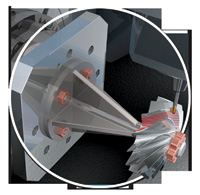 Ease-of-use
is a key requirement for many companies that wish to reduce
the time needed to train new users. This is especially true
for companies that are seeking to introduce production floor
machining, rather than using a dedicated CAD/CAM office for
programming. There are many advantages to be gained from
using machine operators to carry out programming, but
easy-to-use software is critical to a successful transition.
Part of this process will be the development of specific
modules to simplify the programming of different types of
part. Delcam has already introduced such modules for
programming the machining of engine ports and for the
manufacture of blisks and impellers. Similar
highly-automated programming methods will be developed for
other classes of product.
Ease-of-use
is a key requirement for many companies that wish to reduce
the time needed to train new users. This is especially true
for companies that are seeking to introduce production floor
machining, rather than using a dedicated CAD/CAM office for
programming. There are many advantages to be gained from
using machine operators to carry out programming, but
easy-to-use software is critical to a successful transition.
Part of this process will be the development of specific
modules to simplify the programming of different types of
part. Delcam has already introduced such modules for
programming the machining of engine ports and for the
manufacture of blisks and impellers. Similar
highly-automated programming methods will be developed for
other classes of product.
The main changes to Delcam's CAM software will
be in ease-of-use, calculation speed, surface finish,
and flexibility to program new types of machine tool.
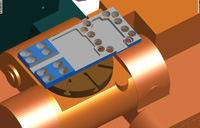 Calculation
speed is a key requirement as machine tools produce parts
more and more quickly. At least part of the improvements
that will be necessary to keep up with these developments
will come from increased computer power. However, developers
like Delcam will also need to adapt their software to ensure
that new, faster machines are not left idle, waiting for CAM
programs. Similarly, developments in machine tools and in
cutting tools will allow improved surface finish to be
obtained. Again, software developers will need to
incorporate these developments into their programs to ensure
that hand-finishing can be minimized or even totally
eliminated. Faster delivery and higher quality will be a key
differentiator for companies to build their businesses so
they will need software capable of getting the best results
from their machines.
Calculation
speed is a key requirement as machine tools produce parts
more and more quickly. At least part of the improvements
that will be necessary to keep up with these developments
will come from increased computer power. However, developers
like Delcam will also need to adapt their software to ensure
that new, faster machines are not left idle, waiting for CAM
programs. Similarly, developments in machine tools and in
cutting tools will allow improved surface finish to be
obtained. Again, software developers will need to
incorporate these developments into their programs to ensure
that hand-finishing can be minimized or even totally
eliminated. Faster delivery and higher quality will be a key
differentiator for companies to build their businesses so
they will need software capable of getting the best results
from their machines.
Finally, the software will need to support the
increasingly complex machines that are coming onto the
market. Five-axis machines and turn-mill machines are
becoming increasingly sophisticated and able to produce
complex parts in a single operation. Support for these
machines will be an important part of our future
developments. Reliable software will be essential for these
machines. As well as handling increased complexity, most of
these machines operate at higher cutting speeds, so making
the costs of damage from collisions even more expensive.
Delcam plc,
www.rsleads.com/711tp-155
 |
| Comments
from Bill Gibbs, President, Gibbs & Associates |
This is a challenging question. How does a CAM product
keep up with its market? GibbsCAM focuses on production
machining, people who care how long it takes to cut a part
because this is a key cost factor in what they do. GibbsCAM
customers mostly cut metal, mostly by turning and milling. A
growing percentage cut plastics and composites. A small
percentage burn their part shapes. The first question we
consider at Gibbs is, "How is this changing?" Overall we
don't believe it is. Technologies that make parts in other
ways all have serious hurdles to overcome before they start
to replace the machining of parts. Material deposition
technologies are fine for prototypes, but they are a very
long way from becoming a production tool and replacing
machining. We see no big changes in the next five years.
 There
are expectable changes in "where" machining is being done in
the world, or in how the economies may change in different
countries. These changes don't have an effect on our product
per se. This is more of an effect in our distribution
efforts.
There
are expectable changes in "where" machining is being done in
the world, or in how the economies may change in different
countries. These changes don't have an effect on our product
per se. This is more of an effect in our distribution
efforts.
 Are
there going to be changes in how parts are machined?
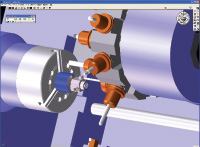
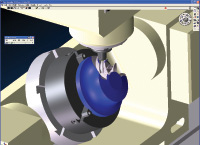
Certainly. There is the continuing growth of CNC multitask
machines (MTM), machines that take raw stock and produce
finished parts by performing the equivalent of multiple
setups automatically. Their popularity is driven by their
ability to reduce the labor cost component of a part and
counter the regional advantage places like China have. As
these machines grow in popularity and complexity, GibbsCAM
will continue to grow its own capabilities to support them.
GibbsCAM is already heavily invested in providing high-end
support for these machines and will continue to do so.
Technologies like five-axis machining used to be for the
specialty shop only. Today five-axis machining is spreading,
and GibbsCAM has new five-axis capabilities to support these
needs.
Are
there going to be changes in how parts are machined?
Certainly. There is the continuing growth of CNC multitask
machines (MTM), machines that take raw stock and produce
finished parts by performing the equivalent of multiple
setups automatically. Their popularity is driven by their
ability to reduce the labor cost component of a part and
counter the regional advantage places like China have. As
these machines grow in popularity and complexity, GibbsCAM
will continue to grow its own capabilities to support them.
GibbsCAM is already heavily invested in providing high-end
support for these machines and will continue to do so.
Technologies like five-axis machining used to be for the
specialty shop only. Today five-axis machining is spreading,
and GibbsCAM has new five-axis capabilities to support these
needs.
Reducing programming and setup times is important cost
savings to an operation. GibbsCAM will continue to improve
its abilities to do both, with capabilities like Machine
Simulation, allowing a customer to virtually set up a
machine without using machine time. CAD integration,
automatic programming methods, and user
customization/automation of programming are all functions
GibbsCAM has today, and will be improving in the future.
Important as these are, machine time is still the big cost,
making machining faster a never-ending goal of CAM and CNC
machines. Supporting new tools and new ways of cutting with
them will continue to develop, and be supported in GibbsCAM
over the next five years. Breadth of CAM capability
continues to be important, as customers prefer to have a
single product handle all their programming. This will drive
GibbsCAM to support an even larger range of machine types.
All in all, we are looking forward to an exciting five
years of product development. This is the best way we can
protect our customers' investment in CAM software and their
business' profitability.
Gibbs & Associates,
www.rsleads.com/711tp-152
 |
| Comments
from Bill Hasenjaeger, Product Marketing
Manager,CGTech |
Wow, five years, eh? Five years seems like an eternity in
the software business. But perhaps CGTech is in a good
position to comment on trends since we are approaching our
20th anniversary providing VERICUT software to manufacturers
around the world. VERICUT sits in a unique position in the
process chain, in between the creation of the NC program and
its physical application on the production floor. Changes at
this end of the manufacturing engineering process are
typically evolutionary, not revolutionary. VERICUT software
development is driven by the evolutionary changes in
manufacturing technology: new CAD/CAM software features, new
machines and tooling, new machining techniques and
processes, and our customers' needs to implement and improve
on these changes.
Following are brief discussions of some general
VERICUT areas likely to see the greatest changes over the
next few years:
For example, in the aerospace industry the trend
over the past several years has been to replace
sub-assemblies made of small components with large
monolithic structures. VERICUT adapted to this trend by
making it easier to view the machining of the entire
large piece, while continuing to be able to analyze
small local areas in fine detail, without reworking or
rerunning the simulation.
User interface
VERICUT's user interface is continually being updated,
with an extensive update every few years because of product
evolution, changing customer requirements and advances in
computer science. With a long-term successful and
widely-used software product like VERICUT, we constantly
adjust for the inevitable clash between intuitive
ease-of-use and expansion of software features (and
user-interface complexity) that naturally occurs when
fulfilling hundreds of customer requests each year. The
latest enhancement to VERICUT's user interface occurred last
year in VERICUT 6.0. VERICUT is due for another
user-interface refresh in the next couple of years, to take
advantage of new interaction methods and to continue to keep
VERICUT easy to adopt and effectively utilize, even for the
casual user. During a user interface update, CGTech improves
ease-of-use while maintaining all the unique and useful
customer-driven features added to VERICUT over the years.
All VERICUT customers: old, new, part-time, full-time,
power-users, and gurus benefit from user-interface updates.
Specialized processes, machines
 Many
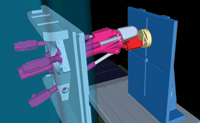
of our customers request VERICUT enhancements to simulate
specialized processes and/or specialized complex machines.
The specialized processes typically reduce production time
or increase process reliability, and often become widely
adopted by many companies over time. Implementing simulation
features for these "special" processes early allows VERICUT
to quickly support the next customers who adopt them. For
example, a few years ago it was rare to see an NC program
utilizing local part coordinate transformations and tool
axis vector programming. Now it is fairly common. VERICUT
supported these features several years ago, when they were
initially introduced. And others have greatly benefited
since.
Many
of our customers request VERICUT enhancements to simulate
specialized processes and/or specialized complex machines.
The specialized processes typically reduce production time
or increase process reliability, and often become widely
adopted by many companies over time. Implementing simulation
features for these "special" processes early allows VERICUT
to quickly support the next customers who adopt them. For
example, a few years ago it was rare to see an NC program
utilizing local part coordinate transformations and tool
axis vector programming. Now it is fairly common. VERICUT
supported these features several years ago, when they were
initially introduced. And others have greatly benefited
since.
Adoption of complex or specialized machines is similar. A
few years ago two-spindle two-turret mill-turn CNC machines
were not very common, but a few VERICUT customers needed to
simulate them and CGTech obliged. Today many manufacturers
utilize "multi-function machines," and CGTech's multi-year
experience simulating them with VERICUT is paying off for
our customers.
CGTech's ongoing enhancements to support unique process
simulation needs for individual customers eventually
benefits other manufacturers as they adopt the same or
similar processes, and will continue to be a keystone of our
support of the manufacturing community.
Speed, speed, speed
 No
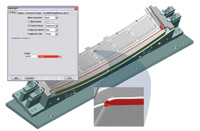
one wants to spend time simulating a machining process.
However, it is a necessary engineering step required because
of today's complex and fast-paced manufacturing environment.
The faster VERICUT can return results and ensure a good
process, the happier our customers are. The time of the
overall simulation is an important consideration in every
VERICUT release. We constantly evaluate frequently-used
sections of the software, inventing and implementing new
algorithms to improve speed.
No
one wants to spend time simulating a machining process.
However, it is a necessary engineering step required because
of today's complex and fast-paced manufacturing environment.
The faster VERICUT can return results and ensure a good
process, the happier our customers are. The time of the
overall simulation is an important consideration in every
VERICUT release. We constantly evaluate frequently-used
sections of the software, inventing and implementing new
algorithms to improve speed.
Additionally, advances in computer hardware help
tremendously. The mainstream use of multi-processors, 64 bit
operating systems utilizing large arrays of fast electronic
memory, and high-speed graphics all benefit VERICUT's
simulation speed.
Use of advanced algorithms and rapid adoption of new
computer hardware will continue to play a major role in our
customer's successful implementation of VERICUT to improve
their machining processes.
Accuracy, accuracy, accuracy
Machining simulation needs to not only accurately
simulate machine motion and CNC logic behavior, it must also
accurately produce a feature-rich representation of the
workpiece being machined. The simulated workpiece must be an
accurate model that faithfully represents what the NC
program is intended to produce. As design requirements
demand more accurate component parts, the simulation
software must improve accordingly.
CGTech will continue its leading-edge development of
unique material removal simulation methods to address the
constantly increasing need to improve simulation accuracy.
Size matters
Mechanical designers always strive to reduce the number
of individual component parts in a product. For example, in
the aerospace industry the trend over the past several years
has been to replace sub-assemblies made of small components
with large monolithic structures. VERICUT adapted to this
trend by making it easier to view the machining of the
entire large piece, while continuing to be able to analyze
small local areas in fine detail, without reworking or
rerunning the simulation.
As individual machined parts continue to trend toward
larger size and more complexity, CGTech will continue to
enhance VERICUT to accurately simulate and analyze large
workpieces, maintaining the necessary accuracy to ensure
even the finest detailed machining is correct.
CGTech,
www.rsleads.com/711tp-153