November 2007 Edition
automotive manufacturing
Lasers and material handling streamline chassis production
 |
| The
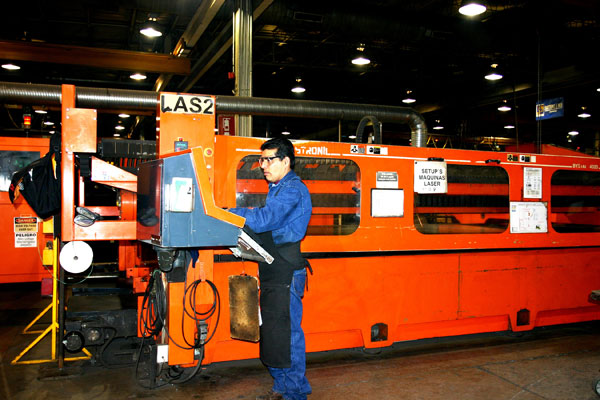
plant's maintenance manager, Emilio Lozano,
calculates that the plant's six Bystar laser cutting
systems boast an average uptime of 97 to 98 percent,
with beam-on-time reaching as high as 85 to 86
percent. |
NACCO Materials Handling Group Inc. (NMHG), a subsidiary
of NACCO Industries, designs and builds internal combustion
and electrically powered lift trucks sold globally under the
brands Yale and Hyster. In the U.S. market alone, there are
more than 130 varieties of lift trucks that lighten the load
for those working in manufacturing, warehousing, retail,
container handling, or heavy manufacturing.
At NMHG's manufacturing facility in Ramos Arizpe, Mexico,
190 miles south of the U.S. border at Laredo, TX,
innumerable chassis await export to the United States. The
steel infrastructure of every model sold in the United
States is prototyped, tested, and put into full production
at this facility. Final fabrication occurs at NMHG's
manufacturing facilities in Kentucky and North Carolina.
Motorized hand trucks and lift trucks are designed with a
range of capacities. Some models can handle loads in excess
of 15,000lb.
Alejandro Oliva, general manager of the NMHG Mexico S.A.
DE C.V. operation, has managed the facility for six years.
During this time, the company has realized a 300 percent
increase in growth. The plant now has six laser-cutting
systems, 360 employees, and a production area greater than
170,000 sq ft. The first two lasers, a Bystar 3015 and a
Bystar 4020, were installed when the facility opened in
1998. Production began in 1999, and additional lasers were
installed as product lines evolved and expanded. NMHG now
has five Bystar 4020's — four with 3.0kW and one with 4.0kW
— and one Bystar 3015, 4.0kW laser. Each Bystar has a
Byloader 4020 material-handling system and a shuttle table.
They also have two automated material storage systems, one
with four shelves and the other with five.
High-speed laser cutting equipment, automation,
and kanban are only three parts of the company's overall
production configuration. To ensure that its daily goals
are met, NMHG follows a set schedule of routine
maintenance that is performed by its employees.
NMHG already had Bystronic laser-cutting systems in its
European manufacturing plants, and results were positive.
The philosophy in 1998 was to bring this same level of
reliability and productivity into the Ramos Arizpe facility.
Oliva says the laser-cutting systems have also helped the
facility achieve better quality. "We have noticed an
improvement not only in our finished edges, but in our
ability to maintain exceptionally tight tolerances," he
says. "The quality of our overall product has certainly
increased because of these systems."
Adding kanban
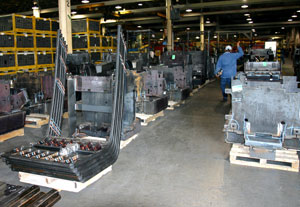 |
| Designed
to lend a helpful hand in the moving of materials,
motorized hand trucks and lift trucks are designed
with a range of capacities. Some models, designed
for tough applications such as steel and logging
yards, can handle loads in excess of 15,000lb. |
Oliva explains that the operation runs three shifts
per day, six days per week. The six lasers process 2,500
tons of metal each month — which equates to 115 sheets of
steel cut every day. On this schedule, seven tractor-trailer
trucks — each hauling 40,000lb of product — leave the
facility at the end of every day. "For us," explains Oliva,
"our high productivity comes from the cutting speed of the
lasers. They are very fast. The only downtime we experience
is when the shuttle tables switch positions or we perform
routine maintenance." In adhering to the lean-pull system,
it is important that every machine on his floor is up and
running.
While most material that enters the NMHG
facility is in the form of plate steel or flat bar in a
range of thicknesses, the lasers regularly process steel
1.5mm to 12mm thick. Occasionally, material up to 16mm will
be processed on the Bystars when accuracy and high
tolerances are specified.
Maintenance manager Emilio Lozano says the lasers run at
roughly 85 percent beam-on-time, an average that includes
material-loading and unloading time as well as minor
adjustments. In being asked about the differing levels of
automation on the various lasers in relation to
productivity, he explains that the kanban card system is
very helpful in maintaining consistently high productivity
on every machine. Lozano explains:
"As part of our lean system, operators know 24 hours in
advance what they are going to cut, so they ask for the
materials they need in whatever thickness required for the
next day's processing. The material is then loaded into the
automation's storage towers or placed next to the Byloader
tables in the sequence in which it will be cut. Our
automation works very well within this system."
High-speed laser-cutting equipment, automation, and
kanban are only three parts of the company's overall
production configuration. To ensure that its daily goals are
met, NMHG follows a set schedule of routine maintenance that
is performed by its employees. Oliva explains that this
initiative is possible because Bystronic machines are easy
to maintain. "After attending Bystronic's maintenance
training programs," he says, "my employees had the knowledge
and confidence needed to do their job.
Easy maintenance
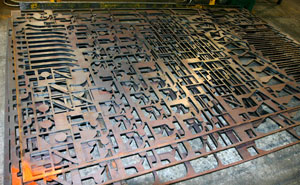 |
| While
most material that enters the NMHG facility is in
the form of plate steel or flat bar in a range of
thicknesses, the lasers regularly process steel
1.5mm to 12mm thick. Occasionally, material up to
16mm will be processed on the Bystars when accuracy
and high tolerances are specified. |
"Every part on the laser systems is replaceable — so
I am able to simply take it out and fix it." Lozano
explains. "Although the technology is sophisticated, it is
very easy to understand." He estimates that scheduled
maintenance for each machine runs 10hr every month. Every
six months, Lozano performs more detailed preventative
maintenance and a thorough cleaning.
Lozano calculates that the plant's six Bystar
laser-cutting systems boast an average uptime of 97 to 98
percent with beam-on-time reaching as high as 85 to 86
percent.
"Our first Bystar laser-cutting machine was
installed in 1998 and has an estimated 45,000 or 50,000
hours on it," says Oscar Llamas, the plant's engineering
manager. He estimates that the uptime on this system is only
1 percent less than that of the newer laser-cutting
machines. "While we choose not to cut thicker materials on
this system, our oldest machine is just as productive as our
newest in cutting thin materials." He says that each of the
six lasers had worked flawlessly 24/7 for over two years. In
2005, they changed to three shifts, six days per week.
"My operators and maintenance personnel like to work with
the lasers because they are sophisticated pieces of
equipment." Llamas continues. "There is quite an element of
pride in going through the Bystronic training courses and in
being certified to repair and operate these machines. We
have found the training very helpful."
Quick programming
At the heart of the machine's user-friendliness is the
Bysoft programming software. The team likes the software,
believing that its capabilities have enabled it to implement
Kanban more effectively. In keeping with lean, it cut only
what is going to be consumed in the line that same day. The
team has established a card system in which every part that
is to be manufactured is represented. On average, the
programmer has 150 parts (or cards) that need be entered
into the Bysoft program and nested before the day's
production can begin.
Pablo Trujillo, manufacturing engineer in charge of
programming, finds the software convenient. "I have never
had a problem with Bysoft. The nesting, the part parameters,
everything, it's all very fast and very easy." He programs
the six lasers to process over 2,000 different parts every
week from his desk. "This task takes me four to six hours
each day," Trujillo says. A time investment that he believes
would increase more than 50 percent were it not for Bysoft.
When Trujillo nests different parts from various product
lines on the same sheet of metal, Bysoft helps track the
diverse part inventory. Llamas explains that Bysoft enables
the team to print out a complete part catalog with
specifications as to each part's thickness, geometry, and
weight. With this feature, anyone on the floor can quickly
identify a part without part etching. "When you have a
multitude of parts running through your machine every hour,
it helps to be able to identify them. Without our Bysoft
software, it would be almost impossible to do what we do
here. You would need an army of people just to do the
nesting," Llamas concludes. Bystronic Inc.,
www.rsleads.com/711tp-150