October 2007 Edition
robots
Force Control Machining cuts manufacturing costs
Improved automated grinding and deburring of castings
Traditionally, the foundry-finishing process was extremely labor-intensive with inconsistent end-product quality because casts were ground, deburred, and polished by hand. Robots used for this task were position-controlled — moving according to defined positions and speeds. If the robot struggled to trace the programmed path, the its servo increased power until maximum torque, causing a collision with the excess materials along the way. As a result, the robot stopped, the tool broke, or the workpiece was damaged. To limit damage, conventional cast-cleaning robots typically ran at a slower pace — limiting productivity.
 |
Force Control Machining is a robot-based
system for improved automated grinding
and deburring of castings. |
Moreover, this conventional approach needed complex and time-consuming programming, as the robot path needed to be as exact as possible. The expectation is that the grinding or polishing would give consistent results. In reality, the cast products were all individual, with different tolerances. This generated inconsistent process results.
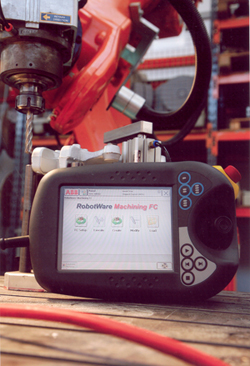
To address these challenges, ABB Robots, Auburn Hills, MI, has created the robotic-based system Force Control Machining, which provides the user with a ready-configured, tested, and verified package. In addition, ABB also has developed a ready-to-produce Flex Finishing Cell concept, in which the heart of it — RobotWare Machining FC — contains two advanced software features. The first, FC Pressure, lets robots grind, polish, or buff castings while maintaining a constant pressure between the tool and the work surface. The second software feature, FC SpeedChange, enables a robot to debur or deflash part line and surfaces of castings at a controlled speed — slowing down when encountering excessive burr.
"The new dedicated robot based system, Force Control Machining from ABB, removes the bottleneck and greatly increases process efficiency — saving time, raising overall consistency, and boosting product quality," says Andrea Eriksson, ABB Robotics' product manager, foundry. "One of the last real barriers to productivity improvement in this sector has been lifted."
The benefits include:
- Improved process results/product quality — Secure controlled-contact force in grinding applications gives an improved and consistent product quality;
- Reduced programming time — 80 percent faster to program grinding applications by allowing the robot to "feel" the surface;
- Shorter cycle time — 20 percent faster deburring applications as the robot adapts to surface defects; and
- Longer tool life — Up to 20 percent longer tool life, as there is consistent wear by avoiding tool and workpiece collisions.
Surface finish
FC Pressure software is aimed at processes demanding a high-quality surface finish. It allows the robot to effectively "feel" its surroundings and follow the casting surface, changing its position in order to apply a constant pressure on the surface, even if the exact position of the surface is not known. As there is consistent contact, debris — such as a burr — is removed to the same depth. This improved force-control accuracy is critical for a good surface finish, where even a 5 Newton force difference can have a huge impact on final quality.
The result is improved surface finish, ability to handle variations in castings, minimum risk of damage to the casting surface, and predictable tool wear. Constant pressure is obtained by adjusting the robot path. Therefore, this function is suitable for polishing, grinding, and cleaning, where a surface needs to be even and smooth. Typical applications in foundry and metal fabrication include:
FC Pressure software is aimed at processes demanding a high-quality surface finish. It allows the robot to effectively 'feel' its surroundings
and follow the casting surface, changing its position in order to apply a constant pressure on the surface, even if the exact position of the surface is not known.
- Grinding of water taps, turbine/propeller blades, and other types of castings;
- Polishing of laptops, mobile phones, electronic parts, water sinks, etc.; and
- Buffing of bumpers, speakers, chromate engine covers, etc.
Accuracy
In processes in which path accuracy is important and finished result must comply with specific dimensions, FC SpeedChange is recommended. With FC SpeedChange, the robot is position-controlled and follows a programmed path that maintains a constant material-removal rate. It operates at maximum process speed and automatically slows down the robot when the machining forces are too high. When FC SpeedChange is active and if machining forces exceed a certain value, then the path speed will automatically be reduced, thus decreasing forces, minimizing changed dimensions due to deflections of the robot arm, and subsequently avoiding damaging the part or tool because of stress and heat.
This results in shorter cycle times; better ability to handle variations in castings; minimized risk of damage to the casting; and predictable tool wear.
FC SpeedChange can be used for:
- Grinding unevenly distributed material on cast surfaces; Milling along the edge of a workpiece;
Deburring along the contours of a workpiece; and
Deflashing unevenly distributed burr along a part line on castings.
- Foundry cleaning operations are now much simpler, enabling finished castings to be produced better, faster, and cheaper," says Eriksson.
Machining applications
The robot-based system, Force Control Machining, provides force control in different machining applications in which the robot needs to be sensitive to process forces. It comprises advanced software (described above), instructions for machining applications, and a computer adapted for force control.
In addition, for full functionality the system contains standard ABB robots fitted with a force sensor; ABB IRC5 controller housing an interface card linking the sensor to the controller's computer; and cabling between the sensor and the controller.
The force sensor measures the process forces used to adjust the robot's behavior. For FC Pressure, either a six-degree of freedom (6DOF) — that is full force and full torque — or a one-degree of freedom (1DOF) force sensor is used.
For FC SpeedChange, either a 6DOF sensor or an analog signal representing the machining forces, such as spindle voltage output, will be used. The choice of sensor input depends on the required flexibility of the application.
"This ABB solution is fully flexible and can be adopted to almost any machining process or system configuration as required by the customer," says Eriksson. "All the benefits of Force Control Machining open up a huge potential for increased productivity and higher quality using robot automation." ABB Robotics,
www.rsleads.com/710tp-160
Let other readers know how the application of this story helped you perform your job better by sending your thoughts to
Tooling@ToolingAndProduction.com.