April 2008 Edition
machining centers
Cox thinking out of aero box
Bridgeport centers run as individual machining cells for Kansas firm
Jason Cox has watched his company's growth from a slightly
different view than perhaps others in the company. As the chief
technology officer of Cox Machine Inc. of Wichita, KS, he's a guy
who thinks about tools and their most effective use, about lean and
cellular manufacturing, and about Six Sigma and Kaizan.
"We really see a continued and strong focus on lean and cellular
manufacturing," Cox says. "We see that's the way to go, and we're
going to invest in new technology, hard technology, like our
Bridgeport machining centers, and soft technology, like the way our
staging areas are set up. That's really where we feel we need to go,
and we feel we've done a good job so far, but we see a lot of room
for improvement."
Bridgeport is key
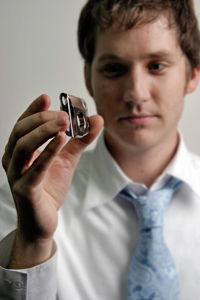 Jason Cox holds a finished socket. This is
part of the latch system that holds the cabin door closed on Cessna business
jets. The parts are machined from stainless steel.
Jason Cox holds a finished socket. This is
part of the latch system that holds the cabin door closed on Cessna business
jets. The parts are machined from stainless steel.
A manifestation of where Cox wants to go can be seen in two
recent acquisitions, two Bridgeport XR 1000 APC vertical machining
centers featuring integrated front-load automatic pallet changers
and 48-tool ATCs with rapid chip-to-chip change times.
"Before we had standard three-axis vertical mills that were
aging," Cox says. "We've chosen the Bridgeports as the vehicle to
drive our efficiency improvements in our vertical milling
operations. On the standard vertical, you can't turn the spindle
while you're changing over and loading parts, and on these you can.
So one Bridgeport easily replaces two conventional verticals, and
that allows us to grow our business without unnecessary workforce or
footprint expansions."
Cox explains the company occupies 75,000sqft and employs 163 in
two locations: In Wichita they do all of the machining and assembly,
and in Harper, just a short run down the road, the company does all
of its fabrication in a facility Cox purchased.
"Primarily, we make structural and control system components and
assemblies for Cessna, Spirit AeroSystems, Hawker Beach, Eclipse,
Boeing and a bunch of others," Cox says. "But we've come to realize
that focusing just on Wichita wasn't broad enough, so we looked
beyond and found clients in various parts of the country — and
beyond. We do some work in Turkey and Italy, but I think all of that
work ends up back on Boeing products."
Cox explains that business is so good, yet it is impossible to
find qualified help.
"Our challenge is to grow with the people we have without
over-working them," he says. "We don't want to make them work twice
as hard. We want them to work the same amount, three shifts a day,
but produce more product, more efficiently and at a better quality.
Also we want to standardize our processes — our lean and cellular
initiatives — and have equipment that lets us do that and use people
with fewer skills, if the need be."
Technology's the answer
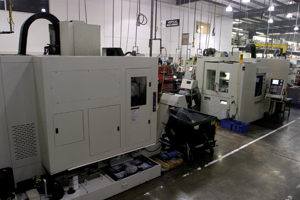 The two Bridgeport APC1000s
set up to run lean, as single-machine machining cells.
The two Bridgeport APC1000s
set up to run lean, as single-machine machining cells.
The Bridgeport XR 1000 APC machining centers feature twin 40" x
20" palettes and 12,000rpm, 40.2hp, 40-taper Big Plus direct drive
spindles. The XR 1000 APCs are quick with a rapid traverse rate of
1,890ipm and X, Y, Z acceleration/ deceleration of 138", 177", and
177"/sec2, respectively. And with X, Y and Z travels of 20" x 24" x
23.6", a workload capacity of 660lbs per pallet, and the ability to
accommodate workpieces up to 13.8" tall, the XR 1000 APCs are
suitable for a diverse range of jobs and machining applications.
Cox says, "Between the increase of spindle utilization from 52 to
93 percent, the increased RPM and increased horsepower, plus the
48-tool ATC with a rapid chip-to-chip change capability, we were
able to replace two of our older verticals with a single Bridgeport
XR 1000 APC.
"It's nice to watch the transition: two older VMCs out, one
Bridgeport APC in. Then, when that worked so well, we did it again —
two out and one in. And this is what we plan to continue to do. It's
this kind of waste removal from the value stream that's a hallmark
of lean manufacturing. Translating that into numbers, we will have
roughly $22 million in sales for 2007, and our growth target is $35
million by 2010."
Typical Cox work
A typical Cox job for a Bridgeport XR 1000 APC would be a smaller
envelope-size part, roughly 4" cubed, says Cox. It would be steel or
aluminum and because of the Bridgeport's high horsepower, it's going
to be hogged out and high usage. Target parts are machined complete
— no secondary operations, like honing or turning.
"We manufacture part of the latch system that holds the cabin
door closed on Cessna business jets, called the socket," says Cox.
"These parts are about 2"x 3"x 0.5" and are manufactured from
stainless steel. We produce four variations for a total of 1,100
parts per year."
'Running a month's parts as opposed to a six-month
quantity really makes a difference: it's beneficial to our
customers and to us. Our inventory turns go up, our available
cash goes up and the customer gets his parts faster. Nobody
loses.' Jason Cox
Cox also manufactures several brackets and stiffeners for Spirit
AeroSystems that go into the Boeing 737 fuselage. These tie pieces
of the structure together, and are hidden from view in the finished
plane. They are machined from aluminum and range from 2"x 2" x 1" to
3" x 3" x 12". They produce 350 of each bracket per year. The
stiffeners are machined from a 10.5lb block, but have a final weight
of less than 0.5lb.
"We typically set up all three or four operations of a bracket on
one table and a different bracket, again requiring three or four
operations, on the other table," Cox says. "The automatic,
two-station rotary pallet swaps the tables in and out. Sometimes we
run a larger part like a stair step for Hawker Beech that has two
operations. We'll set up one operation on each table . . . but
typically we're going to do the smaller parts. Any required
deburring is going to happen as the parts come off the machine. And
after that, the parts go out for final processing. Basically, we're
getting a complete part, minus the sourced finishing operations
(NDI, painting, etc.) with the cycle of each pallet."
In detail
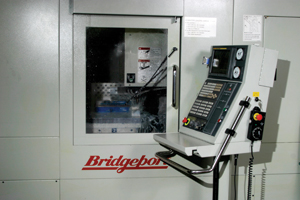 A Bridgeport
APC 1100 running brackets.
A Bridgeport
APC 1100 running brackets.
Cox explains that cycle times of about 15 minutes are average for
the brackets. Regarding precision and rigidity, the Bridgeports are
equipped with Big Plus spindles offering face and taper contact at
the tool holder to increase rigidity. Because of the increase in
rigidity, stability and precision, "We can run extended length face
mills (2" and 3") considerably faster than we could on a
conventional 40 taper machine. Plus, we reduce tool chatter (and
debur) at the same time," Cox says.
In aluminum, which is the most-often material machined, Cox says
on the brackets they can run a 2" diameter face mill, 506ipm with a
0.125" depth of cut.
"If we're running carbide," Cox says, "we can run a 0.750 carbide
rougher at 300ipm with 0.250 depth of cut. So, we can hog the
material out pretty quickly."
Holding tolerances is another bright spot for the Bridgeport
APCs.
"Some of the Sprit brackets have bearings pressed in before they
are installed. We can interpolate the tight-tolerance holes that the
bearings press into and hold 0.0005" on the bore — which is pretty
darn good," Cox says. "Most of the brackets we machine don't require
that kind of precision, but when we do have to interpolate precision
bores we know that we can easily do 0.0005". On parts like the
sockets, we are only required to hold the profile within .010",
which is very, very easy for the Bridgeports. We're running
shrink-fit holders on everything with solid carbide tools or
inserted tools, so in aluminum our tools are going to last through
10 to 15 jobs. It's not like parts per tool; it's more like jobs per
tool, and its 10 to 15 jobs before we have to change.
"As you know, we are focused very keenly and putting a lot of
time into lean, which translates into reduced customer lead time.
Changeover is right smack in the middle of a lean process. The
changeovers we're seeing with the Bridgeports are under an hour for
all the parts, and most of that happens while the spindle is running
another part, so it's off line and external. We continue to improve
as we increase the standardization of the jobs that run on the
machines. Under an hour is not that great a changeover; I'd like to
get it below that.
"A few years ago we ran six-month's inventory on all our
customers' parts, because our setup times dictated that. We'd run
six-months and then hold the inventory for our customers. Reducing
our setups to below the one-hour mark allows us to reduce our batch
sizes. Now we run a month's inventory for our customers that may be
only 24 to 40. Running a month's parts as opposed to a six-month
quantity really makes a difference: it's beneficial to our customers
and to us. Our inventory turns go up, our available cash goes up and
the customer gets his parts faster. Nobody loses."
Single-machine cells
Cox notes that what's evolving is really interesting: the
Bridgeport XR 1000 APC machining centers are each running as
individual machining cells.
"So, with the integrated front-load pallet changer, we can
actually create a one-piece flow in a cell with one machine," says
Cox. "Plus, the 48-tool ATC lets us run a catalog of standardized
tools so we don't have to swap out the cutting tools. This helps,
obviously, in that we run the same tools all the time. Since we've
looked at the Bridgeports as cells, we try to load them with stable
and repeatable work, such as the brackets and sockets.
"Because of this arrangement, we haven't entered new markets, but
we have gone after work that's a bit of a specific breed — that is,
small envelope, high quantity, long-term contract. It's stable work,
repeatable and high quality.
"When we operate this way, we're able to invest more in the front end of the
cell, into standardization of job and process, into our staging areas. We end up
with reduced lead times for the customer and a lot quicker response time to
forecast changes or engineering changes, for example. It's the same market, but
a specific type of part that we've targeted to put through the cells. And this
gives us a competitive advantage over conventional VMCs. We're are able to offer
dramatically reduced lead times for the parts we run on these machines — which
is a huge advantage, here in Aerospace Town or, for that matter, Anywhere Town."
Bridgeport Machines
Inc.
What do you think?
Will the information in this article increase efficiency or
save time, money, or effort? Let us know by e-mail from our website at
www.ToolingandProduction.com or e-mail the editor at
dseeds@nelsonpub.com.