August 2008 Edition
workforce management
Old myths, new realities
As retirements near, firms scramble to fill skilled worker positions
By Peter B. Alpern, Associate Editor
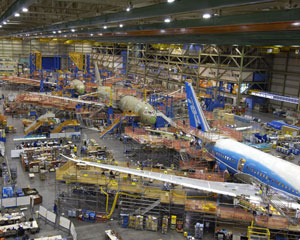 Boeing representatives go on the road visiting college campuses and
attending various expos to encourage applicants to consider the aerospace
industry.
Boeing representatives go on the road visiting college campuses and
attending various expos to encourage applicants to consider the aerospace
industry.
When automaker Toyota announced its plans to open a
new plant with 2,000 jobs in San Antonio two years ago,
its human resources department was inundated with more
than 100,000 applications.
But the task of filling 200 technician positions at
that same location proved far more problematic.
Applicants with the requisite sophisticated skill sets
were all but impossible to come by. Eventually, the
automaker lowered its goal and hired 120 technicians,
many which were acquired from other manufacturers or by
luring workers from other states.
Toyota’s tale is a common one today, highlighting the
challenge companies are facing with greater frequency.
The lack of skilled workers — especially those that are
young — is perhaps the single biggest issue facing the
manufacturing sector today.
Companies have had to adjust rapidly, reinstituting
policies that had become long overlooked, such as
apprenticeships, while collaborating with local
governments and schools to initiate a new workforce.
Some have opened their own universities, while other
manufacturers are offering workers $1,000 bonuses to
workers who recruit technicians.
There really isn’t much time.
One of the foremost changes manufacturers
have made has been the return of a lost method of
development: apprenticeships.
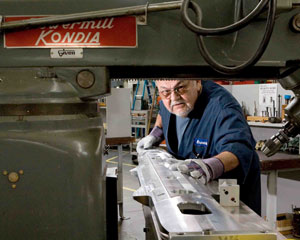 The average
age of Boeing’s manufacturing worker at the
beginning of 2008 was 47.
The average
age of Boeing’s manufacturing worker at the
beginning of 2008 was 47.
As numerous industrial jobs have relocated to
emerging powerhouses such as China, Mexico and Brazil,
precision manufacturing remains a critical piece of the
United States economy, one that is stretched thin and
chronically understaffed.
That shortage of skilled workers is likely to get
worse for the United States as forecasts call for 40
percent of the manufacturing workforce to retire over
the next decade.
A 2005 survey by the Washington, D.C.-based National
Association of Manufacturers reported that 81 percent of
respondents were experiencing a shortage of qualified
workers, a gap that threatens to widen in the coming
years. The average employee in the industry is 55 years
old, says NAM spokesperson Laura Narvaiz.
"I haven’t been to a community where this isn’t a
problem," says Steve Mandes, executive director of the
National Institute of Metalworking Skills, which
provides national standards and third party objective
assessments to the metalworking industry. "It’s
everywhere. And it’s going to get more severe as we
approach the Baby Boomer retirements."
Image problem
 Laser
technology in the automotive industry is growing
with demands for precision and accuracy.
Laser
technology in the automotive industry is growing
with demands for precision and accuracy.
Although the times have changed, the images
associated with manufacturing jobs haven’t — at least in
the public’s eye.
"Someone once told me, when it comes to
manufacturing, people still think it comes down to the
Four D’s: dumb, dangerous, dark, and dirty," says Frank
Quijano, chair of the Industrial Automation and
Engineering Department at Palo Alto College.
Never mind that an industrial technician averages
about $51,585 a year, according to manufacturing
industry figures. By comparison, mean income for
full-time U.S. workers last year was $40,690, according
to the U.S. Department of Labor. Still, surveys show
American youth see manufacturing as a one-way career
track toward poor wages.
Debate rages about how this public perception came to
pass. The common reason cited is the influence of
parents, who dissuade their children toward pursuing
education in the manufacturing trades. More and more
public schools have cut funding for shop programs.
But Keith McKee, the director of the Manufacturing
Productivity Center at the Illinois Institute of
Technology, offers another compelling reason: for a long
time now, manufacturing has sold itself as the job for
anybody, regardless of intelligence.
"This mystique has come about and it isn’t a good
thing," McKee
says. "Manufacturers have done themselves a great
disservice because for a long time, they kept saying
they could hire almost anybody. Most of those people
will never become skilled workers because they’re dumb
as rocks. If you take a rock and train it, it’s still
just a rock."
Restoring a lost tradition
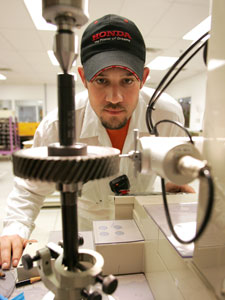 Cory
Carruthers, an associate at the Honda Transmission
Manufacturing plant’s quality control lab in
Russell’s Point, OH, inspects a newly produced gear.
Cory
Carruthers, an associate at the Honda Transmission
Manufacturing plant’s quality control lab in
Russell’s Point, OH, inspects a newly produced gear.
One of the foremost changes manufacturers have made
has been the return of a lost method of development:
apprenticeships.
Apprenticeships have been around since the Middle
Ages, when master craftsmen employed the young as an
inexpensive form of labor in exchange for formal
training in the craft.
As time went on, companies — both large and small —
that viewed the programs as unnecessary expenses did
away with apprenticeships.
"Anything that wasn’t producing an effect on
quarterly earnings got cut at a lot of big companies,"
says Jack Schron, president of Jergens, a
Cleveland-based manufacturer of tooling components and
workholding products. "We brought ours back a few years
ago, but only now have we begun to really emphasize how
important they are."
Jergens has four apprentices in its program, which
mixes their hours between working with mentors,
attending a local college, and taking online training.
"When the recession occurred in 2000 and 2001, most
companies, even the major ones, shelved their training,"
says Mandes, of NIMS. "When they did that, they not only
lost their training staff, but also their institutional
memory of how they did it. Only now, slowly, are they
bringing it back."
NIMS partnered with the U.S. Department of Labor to
establish competencies that are required as performance
baselines in apprenticeship programs.
"You don’t necessarily know if all those apprentices
are all going to make it as workers," says Schron. "But
it puts them on a path where you’re training them and
teaching them how things run the right way. That’s an
invaluable resource."
Collaborating
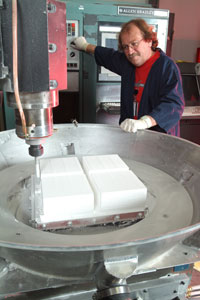 Cutting tiles
for the space shuttle is a job that didn’t exist
just one generation ago.
Cutting tiles
for the space shuttle is a job that didn’t exist
just one generation ago.
Each time Erick Ajax strolls into work each morning,
he is reminded of what his company is facing.
Ajax, owner of E.J. Ajax & Sons, a producer of metal
brackets and latches for household appliances and
industrial machinery, has made workforce stability a
hallmark of his company. More than half his workers have
been with E.J. Ajax & Sons for over 10 years. But now
that workforce is aging at a rapid rate.
"Many of [my workers] are over 50 years old and will
be retiring within the next decade," Ajax says. "It is
now critical that I begin to identify and tap into a
pipeline of capable workers who can replace them when
they leave."
Ajax is one of the leaders in a consortium of local
businesses in Minnesota that has attempted to train
low-income workers, who initially might have modest
skills, into sophisticated laborers in the manufacturing
sector.
The "M-Powered" Project brings together the local
Precision Metal
forming Association, Hennepin Technical College and
HIRED — a local support service for individuals seeking
jobs. The project offers job seekers a two-phased
training program that prepares them for careers in
metalforming. Trainees take part in a 12-week
industry-specific course at the technical college, and
receive career counseling, mentoring, and job placement
assistance.
The Chicago Manufacturing Renaissance Council took
another innovative approach. It launched a project with
the help of local government programs and industry
associations to establish what many in metal fabrication
have yearned for: a school to educate a new breed of
manufacturer.
Austin Polytechnical Academy, a public school on
Chicago’s North Side, was launched this year with 140
first-year students. The school has more than 70 local
manufacturing companies serving as partner organizations
that provide summer internship programs and related
support. Most importantly, says Dan Swinney, chairman of
the council, "The school provides a kind of
‘pre-engineering’ program that takes students through
the big-picture processes [of modern manufacturing]."
Ultimately, some manufacturers took it upon
themselves to train their own employees by building
company-run universities
The school covers the fundamentals behind metal
fabrication and metalworking, so much so that students
will depart with at least two NIMS credentials by the
time they graduate. Combining shop skills with creative
thinking, Swinney says, is a key to the school’s
success. The goal, he added, is for these students "to
become highly skilled manufacturing workers, and even
eventually owners of local manufacturing companies."
The "Dream It. Do It." program, founded in early
2006, seeks to educate and train local residents to fill
manufacturing jobs in 11 different states. The campaign
targets two populations of young adults, 18-34 year olds
and 10-17 year old students, as well as their parents,
teachers and guidance counselors.
The campaign also seeks to better clarify industry
needs with educators.
"We’ve really concentrated on getting the educators
and industry folks in lockstep," says Dwayne Probyn,
executive director of the Nebraska Advanced
Manufacturing Coalition, which supports the state’s
‘Dream It. Do It.’ campaign. "I think for a while,
educators and manufacturers weren’t working in tandem."
A new approach to learning
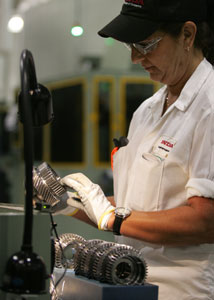 Sophisticated
skill sets are required in automotive gear
inspection.
Sophisticated
skill sets are required in automotive gear
inspection.
Observers saw the problem as not just the age of
workers leaving and those replacing them. It was also
the quality. Young workers were either inadequately
trained or simply didn’t have the competency skills to
run sophisticated machinery.
Ultimately, some manufacturers took it upon
themselves to train their own employees by building
company-run universities.
In 2000, Jergens launched Tooling University as a
means of training its own employees to enhance their
basic skills and knowledge of metals-based
manufacturing. Within two years, it was opened to the
public, with large corporations such as Caterpillar,
General Electric, and SGS signing up employees for
online classes.
Machine builder Mori Seiki had a similar approach in
2006 when it opened Mori Seiki University to develop the
job skills of its own workers. But the more Rod Jones,
chief learning officer at MSU, interacted with
customers, the more he saw a gaping industry-wide need
for knowledge.
Mori Seiki’s online program Education on Demand uses
advanced computer graphics to teach users how to operate
manufacturing equipment.
"It’s given us an opportunity to not replace our
existing training, but certainly to augment it," Jones
says. "We can reach thousands of customers and get that
first 30 to 40 percent of training done. It’s the next
best thing to having your hand pushing the buttons on
the post generator on a control panel."
When Toyota agreed to build an assembly plant in
Tupelo, MS, back in February, part of the $293.9 million
incentive package the company received from the state
included the costs for building a training center at
University of Mississippi to train students for
manufacturing.
The tide hits everybody
Boeing’s manufacturing manager, Tommy Small, spends
nearly half the year on the road visiting college
campuses and attending various symposiums and expos. The
company name on his shirt all but assures he’ll have no
shortage of attention.
Students closing in on college graduation are eager
to learn about employment at the nation’s largest
manufacturer of commercial airplanes and aerospace and
integrated defense systems.
But even Boeing hasn’t been immune to the workforce
crunch.
According to Boeing spokesperson Cindy Wall, the
average age of the company’s manufacturing worker at the
beginning of 2008 was 47.
If name recognition assures a heavy stream of young
graduates eager to join the company and makes recruiting
from rival manufacturers easy, it’s hardly an end-all
solution.
"The fact is, most of the precision work in our
industry is done at second, third, and fourth tiers,"
says NIM’s Mandes. "That’s where the skill problem is.
If you assemble everything at tier one, all the critical
components are still manufactured in the supply chain —
and that’s happening at the smaller companies."
‘The fact is, most of the precision work in
our industry is done at second, third, and fourth
tiers. That’s where the skill problem is. If you
assemble everything at Tier I, all the critical
components are still manufactured in the supply
chain — and that’s happening at the smaller
companies.’ — Steve Mandes
Many have begun offering retirees, who already are
pulling down a pension, additional work on either a
part-time or limited basis. But such measures are merely
short-term answers to long-term problems.
How to change with the times is something the Tooling
& Manufacturing Association has been mulling for years.
The Chicago-based 1,250-member organization of precision
manufacturing and supplier companies has long devoted
itself to advancing manufacturing to young people.
But enrollment in the program is lagging. TMA
President Bruce Braker says despite efforts to
modernize, over the last 40 years enrollment has sunk 93
percent. In the late 1960s, the apprenticeship program
had 1,500 students. Now it has 100.
"One of our major problems is that high schools are
not as committed to manufacturing-related technology
education," Braker says. "Anything that can correct the
perception that manufacturing is dying is a good thing.
Manufacturing isn’t dying. It’s changing, and we need to
change along with it."
Toyota Motor Sales USA Inc.
National Institute of Metalworking Skills
Jergens Inc.
E.J. Ajax & Sons Inc.
Mori Seiki Co. Ltd.
Boeing Co.,
Tooling & Manufacturing Association
What do you think?
Will the information in this article increase efficiency or
save time, money, or effort? Let us know by e-mail from our website at
www.ToolingandProduction.com or e-mail the editor at
dseeds@nelsonpub.com.