July 2008 Edition
inspection solutions
Quieting the EMI racket
Wireless mesh networks can ensure data arrives uncorrupted
By Jeff Wilkinson
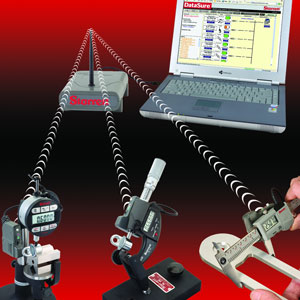 Each DataSure system supports up to 100 active tools allowing data
transmission from various plant locations to central DataSure Gateway.
Each DataSure system supports up to 100 active tools allowing data
transmission from various plant locations to central DataSure Gateway.
Electronics as a group are some of the most mechanically and
performance-fragile systems that live in industrial environments. Within those
environments are frequent examples of noise and interference sources that
disturb or otherwise impair the reliable functioning of electronics.
While heavy steel packaging and seal rings keep harmful, volatile, and
corrosive liquids and particles out of sensitive electronics, they cannot
protect the emissions of radio waves in wireless networks. Wireless sensors and
metrology instruments frequently are being deployed in production areas.
The wireless systems deliver their quality or production data to critical
operations downstream and are crucial components of the modern production
reality. With this said, wireless data transmission of data is critically needed
and simultaneously vulnerable to shop-induced interference.
Radio frequency (RF) waves are the carrier for data in a wireless data
acquisition system. These waves are simply energy propagated through free space.
When free space is cluttered with other energy forms, intentional radio waves
are compromised.
RF is highly susceptible to corruption and alteration via a variety of
Electromagnetic Interference (EMI). EMI has been defined as the "degradation of
the performance of a piece of equipment, transmission channel, or system caused
by an electromagnetic disturbance" (ANSI). EMI can occur throughout the EM
spectrum from
0 Hz to 20 GHz or higher frequencies.
There is no such thing as a 100 percent noise-immune
radio system. Systems designers must develop robust wireless
data collection networks and sensors to be less susceptible to
EMI.
However, EMI problems are most prevalent in the RF spectrum. Since in many
applications the RF carries the data, then good RF handling must be encouraged
to keep the data intact.
If there is EMI, RF-based systems must manage their performance relative to
interference if they are to be useful. There is no such thing as a 100 percent
noise immune radio system. So with that truth, systems designers must develop
robust wireless data collection networks and sensors to be less susceptible to
EMI.
There are many techniques that designers can use to offset the impact of
EMI-generated noise in a wireless network. The mesh network is an
option that has some distinctive features. First, it has a single and central
"gateway" function where all system wide commands and network management can
occur. Data from the network also returns here.
Secondly, the sensor/measurement endpoint radios can be active components of
the network.?Thirdly, numerous routers or repeaters are present and can be added
to enable multiple paths for OTA (Over the Air) transmissions.
The mesh is inherently robust to interference by the nature of the system
configuration. For example, observe what happens to the OTA flight of the RF.
Figure 1a shows how as the endpoint radio acquires data from its measurement
tool or sensor and transmits it to the gateway, a plume of EMI from an induction
hardener cancels the RF in the immediate vicinity.
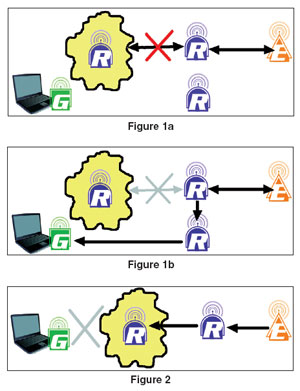
Adjacent to the first router, other routers (Figure 1b) have also received
the data transmission. Once the blocked router has found no data was received,
it cannot pass along any data to the gateway. Simultaneously, the other routers
have the good data and attempt to send that data to the gateway.
In a mesh network, the data may make a series of router hops until it reaches
the gateway. While this is happening, other copies of the data are en route.
When the gateway sees an exact copy of already received data, the gateway
discards the additional copies. Endpoint radios on the network have a unique
"address" which allows only the intended data to reach the gateway without
duplication.
In addition, when EMI is not present and optimal operating conditions exist,
the mesh network speeds OTA transmission by constructing a routing table in each
network element. The router table creates a predetermined path for data, which
allows the other routers in the network to be either idle or available for other
endpoints to be received.
Some of the key advantages of wireless data collection are freedom from the
bench, host PC’s, wires, and the limitations of bringing a part for inspection
to the tool.
However, with wireless systems, data being recorded may not be immediately or
readily visible.
Advanced systems for wireless data collection have indicators/enunciators on
the data transmission device itself, to show the operator the status of the
system and the successful transmission of data. In many systems, the end node is
"unaware" that the network or host PC loses power, and therefore, data will not
be recorded.
But, if the endpoint has the ability to show the user that data transmission
has failed, a few good things can result. The operator can immediately see that
there is a problem with the network and correct it. Conversely, without any
system status indication, the operator can unknowingly corrupt his own data
collection.
With a feedback method of system status oriented to the user, data can have
more integrity. However, when the user ignores or misses the feedback, data can
still be corrupted. As an additional safeguard to lost data, the endpoint radio
can incorporate a means to store data recorded when the main systems is down.
Modern wireless data collection system designs incorporate a storage feature
that collects any data "taken" at the endpoint and holds it until the system
becomes available again. All the while data is being stored on the endpoint, the
endpoint radio alerts the user with the feedback system described above and
waits for the system to come back online. Once the system is back on line, the
endpoint will dump its data to the gateway/PC host system. No data is lost, even
though the main system has failed.
With DataSure, there is a system feature that communicates between endpoint
and gateway and seeks to ensure that uncorrupted data arrives at the gateway. If
the system tags the data sent with a CRC or parity error, the gateway informs
the endpoint to resend the data again from the endpoint’s temporary memory.
Data is then sent again, up to 10 times, insuring good data ultimately gets
to the data set. If data is received as good, then the gateway informs the
endpoint to discard its temporary memory of that data, so that it won’t get sent
again. The temporary memory is only held until the gateway validates successful
receipt of the data.
In one test, successful transmissions have been recorded with zero failures
in 3.5 million measurements. This is an example how data collected in the field
show remarkable performance figures.
L.S.
Starrett Co.
Jeff Wilkinson is general manager of the Starrett Advanced Technology Division.
What do you think?
Will the information in this article increase efficiency or
save time, money, or effort? Let us know by e-mail from our website at
www.ToolingandProduction.com or e-mail the editor at
dseeds@nelsonpub.com.