June 2008 Edition
machining strategies
Rethinking throughput
for 700-plus customers
New approach brings 10-to-1 productivity gain for precision parts maker
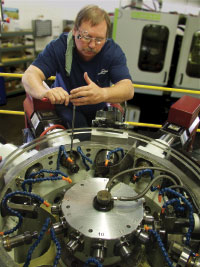 Lloyd Comer, supervisor of the rotary transfer department, ratchets up another changeover on the EPIC R/T 12.
Spokane, WA, producer of precision electronic
parts wasn’t foiled by some of the challenges it was facing — overseeing 45,000 designs cut from various
materials, reducing cycle and changeover time, and serving over 700
distributors and OEMs around the world.
Company representatives got together,
brainstormed, and went shopping. What they discovered brought an
astounding 10-to-1 gain in productivity.
Secondary operations had been a major stumbling
block for Lyn-Tron Inc. The answer laid in making completed parts on
a single machine that was flexible, fast to set up, and quick to
change over. So CEO Don Lynn and Dominic Borland, vice president of
manufacturing, sought some solutions.
Borland and production manager Mike Quinn went to
Hydromat Inc.’s St. Louis headquarters to look at standard
hydraulic-driven machines.
"We were doing custom part jobs on CNC machines
in big quantities, and after investigating the Hydromat machines, we
thought we could do some of those large custom runs on one," Borland
says.
But something happened. Borland couldn’t keep his
eyes off the EPIC R/T machine. He was curious about the Embedded
Motion Control (EMC) technology that features a special
plug-and-play control architecture embedded into each tool spindle
unit.
EMC was a relatively new technology when first
encountered by Borland and his team. Its plug-and-play programmable
valves are integrated, or embedded, into each tool spindle unit,
offering fully independent functionality for each axis motion. Thus,
the more complex CNC control components are eliminated.
Should a tool spindle be relocated on the
machine, the only change needed is to program the unit’s tool passes
and revolutions per minute. When tool units are changed, there is no
need to reconfigure the machine’s CNC.
The price of evolution
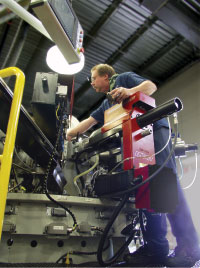 Comer concentrates on setting up the EPIC R/T 12. EPIC’s program will let the technician know when it’s time to change a tool.
The only question facing Lyn-Tron — and it was a
sizeable one — was cost.
"It’s the most expensive machine we have ever
purchased," Lynn admits. "I sent them (Borland and Quinn) out there
to look at this one machine, and they come back wanting a different
machine … and a lot more money. But you know what? They were right."
The EPIC R/T CNC-controlled rotary transfer
machine has a price tagcomparable to the non-CNC Hydromat machines,
according to Hydromat.
Lynn and Borland worked with Bill Nuetzel,
Hydromat regional sales manager, and staff to select a machine,
which turned out to be the Hydromat EPIC R/T 25-12. Its modular
system design allows for up to 12 horizontal and six vertical tool
spindle units, mounted around a precision-ground Hirth ring. Table
accuracy with station-to-station repeatability is within 0.0002".
With a 25.4mm capacity, the machine accepts bar
stock or blanks up to 102mm in length. A stationary workpiece can
undergo machining such as drilling, cross drilling, boring, turning,
milling, external and internal recessing, threading, tapping, or
broaching.
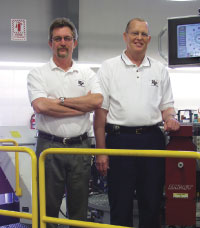 Dominic Borland, vice president of manufacturing, and Don Lynn, CEO, took on the task to find how to eliminate secondary operations and to make parts complete on a single machine.
"It is a fabulous machine," Borland says. "We do
a changeover every 30 minutes and setups every two to three hours.
Currently, the custom jobs we have account for about 25 percent of
our work. We want to expand more into the custom area."
Borland says that if Lyn-Tron were to manufacture
2.5 million parts of the same item, running day in and day out, then
the hydraulic Legacy machine would have been sufficient. But he knew
that the processes would be going from aluminum, to brass, to
stainless steel, from one part configuration to another. Quantities
would range from 1,000 to 10,000 pieces.
Borland says the flexibility of the EPIC R/T
machine was needed.
"We run a single part from a family in a quantity
as small as 1,000 pieces," he says.
And how many setups and changeovers will they do
in a typical month on the Hydromat?
"You’d be surprised," Lynn says with a laugh. "We
would probably average 35 a month. We may do a couple of changes in
a day."
A learning curve
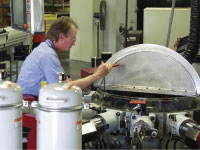 Setup technician Bob Hammond applies some torque to complete a change-over.
When the machine was installed at Lyn-Tron, it
was to produce a custom part. After awhile, Lyn-Tron shifted some of
its existing work off the CNC machines that were running cycles
anywhere from 25 to 35 seconds. On the EPIC, in shorter runs, cycle
time was 3.5 to 5.5 seconds.
"They immediately saw a 10-to-1 productivity gain
and thought, ‘Man, this is pretty nice,’" Nuetzel recalls.
Today, Lyn-Tron has over 275 different parts
programmed to run on the EPIC, and man-hours have dropped in the
other CNC machine areas, all adding to the bottom line. The company
uses 30 multispindle lathes, 11 Swiss CNC lathes, seven rotary
transfer machines, and eight Brown and Sharpe machines.
Borland says Lyn-Tron usually runs a series of parts within a
family, often by part type rather than material type. If the next
part is close to being the same as the previous run, operators will
wash down the machine, reload it with different material, change
speeds and feeds in the EPIC program, and start running again.
"We may have some parts that are in a series for
a particular customer," Lynn says. "They will have five or six parts
that are similar, and we can just back those up and run a 1,000 of
this, 3,000 of that, and 5,000 of another. It’s worked out real
well. Once they get the job going, it’s just check the parts and
that’s it."
Durability, efficiency
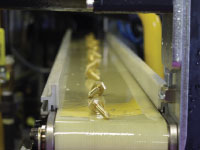 Completed parts rapidly drop on the conveyor.
Borland says he is impressed with Hydromat’s
durability.
"You can buy a cheap multispindle lathe, but you
better add a few thousand dollars to the equation for replacement
parts over the next few years, and that’s not counting
loss-of-production due to downtime," he says. "If you figure you’re
going to run 70 percent (efficiency) on a multispindle lathe,
compared to 85-90 percent on a Hydromat, you have to figure that
into the equation as well."
Expanding on his theory as to why the Hydromat
gives him a 15- to 20-percent advantage, he says, "The machine is so
rigid, the tooling really lasts on it, so once the first article
goes in, they (technicians) don’t have too many problems."
Borland says the EMC technology adds to his
up-time.
"If we are running stainless, the guys know how
long a tap lasts, so we put the parameters into the EPIC’s program,
and it will let the technician know when it’s time to change the
tool," he says. "Then we just keep running. We don’t get that on any
of the other machines that we have."
Lynn says the Hydromat’s true value lies in its
efficiency. He says there are a lot of costs with a multi-spindle
machine that have to be calculated when comparing it to a rotary
transfer machine. And Lyn-Tron is getting a greater up-time and less
need for maintenance.
"That’s the big picture we’re talking about,"
Lynn says.
Soon, twice as nice
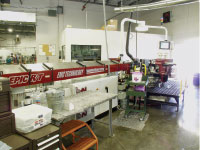 This reverse angle shows the parts conveyor for the EPIC R/T.
Having seen the EPIC machine’s capacity, Lyn-Tron
already has another machine on the way.
"We get a lot of prints for custom jobs that are
similar to our products, so we are looking for that custom ‘transfer
type’ of work on a daily basis," Lynn says. "We have a couple
thousand of those type of customers throughout the world."
With an extensive part catalog, regional
representatives, and about 700 distributors and OEMs around the
world, Lyn-Tron is well diversified.
"We don’t have any customer that is any more than
10 percent of our business," says Lynn. "We have a lot of customers
who only do a few hundred dollars a year with us. They’ll call in a
couple of times a year and buy $100 worth of parts off the shelves."
In short, Lyn-Tron’s efforts not to put all of
its eggs in one basket ensures a constant workflow and avoids
downturns.
"I’ve seen that happen at other companies," says
Borland. "They lose one big client and they’re laying people off.
We’re not dependent on any one client for our survival."
Not surprisingly, Lyn-Tron’s business is growing,
but with a smaller organization.
"We’re producing a much larger dollar volume per
employee than we did before," says Borland. "That’s our goal every
year: raise our volume without raising the number of employees we
have. We do that through technology. Lean and mean!"
Don Lynn reaches back to the philosophy that has
served him and his company well since 1973, when it began.
"On some of our first CNC machines, a part may
have run in 22 seconds," he says. "The next generation of CNC
machines would run it in 16 seconds, then 12 seconds, and so on.
"Now we have the Hydromat EPIC and we’ve taken parts that we were
running in 20 to 30 seconds and we run them in 4 to 6 seconds.
That’s progress."
Hydromat Inc.
What do you think?
Will the information in this article increase efficiency or
save time, money, or effort? Let us know by e-mail from our
website at
www.ToolingandProduction.com or e-mail the editor at
dseeds@nelsonpub.com.