June 2008 Edition
five-axis solutions
Setting a standard
With flexibility and advantages, process becomes an industry staple
 As five-axis technology has matured and its popularity has spread, machine
builders have begun to respond by moving “down market.†This is Hermle’s new
B 300.
As five-axis technology has matured and its popularity has spread, machine
builders have begun to respond by moving “down market.†This is Hermle’s new
B 300.
Initially developed in the 1950s to meet the demand for a new
generation of parts, the five-axis machining center cut its
eyeteeth on aircraft impellers, medical tools and appliances,
customized cutting tools, and other applications that would be
impossible or impractical to produce without five-axis
capability.
Early five-axis machines were limited in function, difficult to
program, and required excessive verification throughout the
machining process. The lack of any standard controls and toolholders
further complicated matters.
Today’s five-axis machining center, with CAD/CAM programming and
solid modeling, is a far cry from those early efforts. Such a center
will allow five-axis machining simultaneously. Lessons learned in
working with newer alloys have resulted in an emphasis on rugged
construction. Control builders have evolved systems that are user
friendly and easy to program.
Hermle Machine Co. of Franklin, WI, a subsidiary of
Maschinenfabrik Berthold Hermle AG of Gosheim, Germany, was among
the first to capitalize on the demand for five-axis machining.
"For many of our customers, five-axis was a natural next step,"
says Kenneth Merk, executive vice president-sales and service. "Hermle
has already had a reputation for producing ruggedly built and
extremely precise machines.
"Twenty years ago, many of our units went into research
laboratories and prototype facilities — the very people who were
developing the first generation of today’s complex parts. They were
among the first to appreciate five-axis capabilities and, as we
responded to their demands, we developed machines that were really
ahead of their time."
Merk says as a result, five-axis became Hermle’s particular
market niche. In fact, for more that 10 years now, five-axis units
have accounted for more than 90 percent of the company's sales.
Demand increases
Thanks largely to five-axis capability, Marten Machining Inc., of
Stevens Point, WI, continues to grow and expand by serving the
prototype market.
"The market for highly complex prototype parts continues to grow,
and we found that five-axis is the only way to go to meet that
demand," says Al Marten, owner. "We consider ourselves an extension
of our customers’ engineering departments and our products reflect
that. Thanks to the flexibility of our five-axis machines, we’re
able to quickly turn out a wide variety of different prototypes and
repeat parts.
"We receive all of our CAD files by e-mail and, seconds after it
leaves the customer, we import it into our CAM system and input the
data into our machines," Marten says. "That way, we can provide the
fast turnaround that our customers demand."
Marten Machining has continually added to its lineup of five-axis
machining centers and with the aid of a robot has linked two of them
into an unmanned machining cell. Marten also operates two
single-machine cells.
The ability to quickly generate complex parts in small batches
through the use of five-axis machining centers has powered Essai
Inc. to the top of Silicon Valley’s Fast 50 list.
Founded by Iraj and Nasser Barabi to serve companies producing
semiconductor chips, the company manufactures parts used to connect
chips to the testing system and manage the chips throughout the
process.
"Our largest parts are 6" x 2"," says Nasser Barabi. "Although
most are in the 4" range, some measure less than 1" in size.
Thicknesses are from .04" to 2", and materials include high-end
plastics, copper and steel."
Extremely exacting
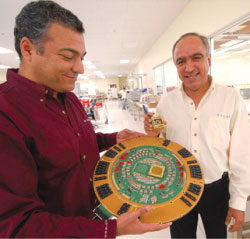 Iraj and Nasser Barabi of Essai Inc. continually re-engineer existing
components.
Iraj and Nasser Barabi of Essai Inc. continually re-engineer existing
components.
Machining is extremely exacting, as most parts require 20 to 30
operations and must be machined on four to five sides. Tolerances
can be set as high as .0001 and cycle times can extend from 15
minutes to three hours. On average, each part requires the use of
about 20 different tools. Typical volumes range from two parts to
several dozen per order.
To minimize external intrusion with the production process, Essai
utilizes a fully automated system capable of three-shift production.
Two five-axis machining centers equipped with 280mm NC swiveling
rotary tables and tool magazines extended to 189 pockets are linked,
via a pneumatic extension, with a pallet-handling system capable of
storing up to 180 parts.
"Without five-axis flexibility, it would be impossible to
accomplish what we do," Nasser Barabi says. "Last year, we
integrated 3,000 new designs into the process, and this year we
expect to include over 3,600. Also, we are continually
re-engineering existing parts and changing quantities."
As higher production quantities across the spectrum of parts
sizes have become a fact of life for five-axis users, builders have
responded with a variety of solutions.
"At Hermle, our orientation has changed," Merk says. "We once
thought of five-axis in terms of the individual machine producing
one part at a time, but now we’re much more involved in mid-level
production quantities. For instance, our C Series utilizes
compatible, proven features such as three-rail geometry, a
heavy-duty trunnion table, and a mineral casting base to machine
multiple five-axis parts in all size ranges."
Merk says a variety of workholding options have been introduced
for machining small parts or large oversized applications.
"Our pallet changers are designed to operate in stand-alone mode
and to allow easy access when operator intervention is required," he
notes. "We’ve also developed strategic partnerships to provide fully
automated systems that are part sensitive and cost effective."
Growth in toolmaking
Not surprisingly, toolmaking is one of the areas in which
five-axis machining has experienced phenomenal growth.
Great Lakes Custom Tool Manufacturing of Peshtigo, WI, produces
cutting tools for the woodworking and metalworking industries.
Although a high percentage of its work involves customized tooling
featuring highly intricate profiles, the company has developed
several patented proprietary lines that are produced in mid-sized
quantities.
"Once you start with five-axis and see what it can do, you always
want more," explains Ray Martin, vice president of operations. "We
started with one machine and now have several. Everything we make is
held by a shank or bore, and five-axis capability has really
simplified setup time.
"This is especially true with some of our more complex tools such
as helical cutters," he says. "For other products, we’re able to do
multi-sided machining in one setup."
Ease of setup has also been a key factor in moving to five-axis
for TNT EDM located in Plymouth, MI. Originally founded as a
dedicated EDM shop serving the plastics injection molding industry,
the company added five-axis capability in 2000 and has since
purchased multiple machines.
"Five-axis has fueled much of our recent growth, and we continue
to add more machines," says founder and president Tom Mullen. "Once
we saw the kind of things we could do, we started going after
machining business, as well as EDM, and we’ve been extremely
successful.
"We’ve also moved some of our EDM work to the five-axis line
because we’ve been able to accomplish some of the jobs with up to a
30 percent savings in time."
Mullen has also found other ways to achieve savings in time and
money with five-axis.
"When you’re involved in hard machining, tooling is one of your
greatest expenses, and we have to maximize tool life across the
board," notes Leon Carpenter, project manager and programmer at TNT.
"Five-axis delivers better accuracy and the ability to optimize
cutter lengths.
"We’ve also achieved tremendous savings by putting three- or
four-axis jobs on the five-axis machine. Because the five-axis is
versatile enough to approach the part from multiple sides and
angles, you can generally get by with a more simple fixture, and you
also save on operator hours."
Microscopes needed here
Mark Plesnik of Owens Industries, Inc., in Oak Creek, WI, also
discovered an instance in which five-axis technology outperformed
his expectations.
Known primarily for extremely exacting applications involving
small-sized parts (at Owens, microscopes can be found at the
machining stations), Owens made the move to five-axis machining when
challenged by an engineering company that had designed a fire
suppression device for use in the oil industry.
"The part was considerably larger than most of our output and was
made of nickel alloy," Plesnik says. "Tolerances are extremely high,
and surface finish is crucial where two parts meet to form a seal.
"The part is turned prior to machining, and we realized that the
only way to hold accuracy and complete operations in a reasonable
amount of time was to minimize the number of setups. That could only
be done with five-axis."
Prior to contacting Owens, the customer had been unable to find a
company willing to produce the parts in quantity — much less at a
reasonable price.
By refining the program, Plesnik and his team were able to
complete machining operations including milling, horizontal and
vertical drilling, tapping, and profiling in one setup. They were
gratified to discover that they had achieved an 8-micron finish on
the seal without lapping — thereby eliminating other operations.
Machining time was 4.5 hours, but as Plesnik states, "Without
five-axis capability, it could take more than twice as long and
necessitate multiple set-ups."
As five-axis technology has matured and its popularity has
spread, machine builders have begun to respond by moving "down
market."
"We know that there is a large potential customer base that is
quality conscious but more price-sensitive than our traditional
buyers," Merk says.
To meet the needs of that market, Hermle now offers the B 300,
called an entry level Hermle, that incorporates many of the design
features found in the C Series machines in a modular standardized
package. The B 300 is priced at just under $300,000.
As five-axis has revolutionized much of the technological side of
manufacturing, it has had an equal impact on the concept of
justification. When large-volume orders were the norm, the cost of a
machine was typically justified over the volume of the parts run.
"Most of our customers can’t financially justify a machine on the
basis of a single order, but they know that five-axis parts are the
shape of the future," Merk says. "And, if they’re going to succeed,
a quality machining center is the price of admission."
Hermle Machine Co.
Integrate a five-axis machine to maximize its effectiveness
Companies are finding advantages to five-axis machining centers
not offered on traditional three-axis machines — for example, no
more multiple setups across several machines. In return, this often
streamlines workflow, improves productivity, and reduces the chance
of inaccuracies.
Five-axis machining can also be a plus for tool performance.
Rotate a part along the b- and c- axes, an operator maximizes
efficiency of the tool’s angle efficiently and improves surface
finish. Tool life can be boosted by up to 60 percent this way.
Quality, as well, improves.
Even training has taken on a new face. User-friendly CAM software
packages that support five-axis are easily available, and
tool-path-verification simulations help eliminate the risk of
interference between any components within the machine. Operators
well versed in three-axis programming often can make the transition
to five-axis within one week of quality training.
New ground is constantly being broken in five-axis machining, and
companies need to find the latest information. Mori Seiki, for
example, recently introduced the NMV8000 DCG with DD (Direct Drive)
Motors on the axes. Compared to the servo-motors and worm gears used
on previous five-axis machines, DD Motors eliminate backlash to
improve accuracy.
The evolution of five-axis machining has provided companies a
tool that with correct integration could increase their competitive
advantage in the global market.
Mori Seiki