March 2008 Edition
aerospace manufacturing
Hypersonic aero builders
reach for every advantage
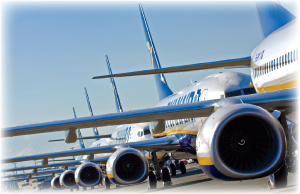 From the standpoint of machine designers,
builders, and end-users, the aerospace market seems to be moving at
a hypersonic pace. With demand for military as well as commercial
aircraft continuing to grow, the demand for speed to market is
pushing not only the machine tool companies themselves but also such
allies as Siemens Energy & Automation Inc.
From the standpoint of machine designers,
builders, and end-users, the aerospace market seems to be moving at
a hypersonic pace. With demand for military as well as commercial
aircraft continuing to grow, the demand for speed to market is
pushing not only the machine tool companies themselves but also such
allies as Siemens Energy & Automation Inc.
"I've never seen it before," says Tim Shafer,
Siemens director of aerospace. "I've been in and around the industry
for years, and I've never seen the commercial and defense aerospace
airframe segments hitting stride at the same time. And I'm talking
in terms of just airframe components right now. If you go over to
the jet engine side, they're going through a very similar challenge.
Remember, for every airplane that you build there's at least one
engine, and usually two engines, that go along with it. That
capacity, with blisks and so forth, is highly reliant on five-axis
machining."
In turn, today's machining community — in effect,
a global network building parts for everything from F-35s and Boeing
jetliners — looks to a company such as Siemens for an arsenal of
technological advancements. Siemens has gladly obliged with such
products as SINUMERIK 840D CNC as well as with what the company
calls "advanced services," including:
- Virtual Production, through which virtual
machining and optimization during simulation replaces any
repeated test machining of the workpiece on a machine. As the
automation solutions company boasts, "using in-house-developed
simulation software, optimization is possible even in the
preparatory phase of production."
- Mechatronic Support, which plays on the
company's promise to customers to be "faster to the machine,
faster on the market." For Siemens, this means going beyond
mechatronic products and systems; it is pushing a service
envelope "by configuring, developing, and testing the
mechanical, electronic, and computer science components in
interdisciplinary teams."
- EPS Condition Monitoring, with Web-based
services that record plant status and allow for predictive
maintenance.
- In today's aero market, every advantage is
critical. As Shafer notes, "What I see in the aerospace market
is robust growth in five-axis machining and composite
technologies for the next two or three years."
Hitting stride
New materials, from titanium to aluminum alloys,
are part of the aerospace manufacturing scene, creating new cutting,
tooling, and workholding challenges. Moreover, the demand for
finished products that can drill holes in the sky is putting
pressure on almost every machine tool builder, according to Shafer.
"The discussion that I've had with the primes and
in the supply chain is that there is a great concern about the
supply chain capacity to machine five-axis parts," Shafer tells
Tooling & Production. "And I've heard estimates of more than
1,000 five-axis machines being added to the capacity to make the
rates that are being driven by new programs such as 787 and F-35
over the next three to five years.
"Obviously," he adds, "there's this tremendous
upturn in business, with all these programs hitting stride at about
the same time. And then there's Airbus and Boeing talking about a
tremendous increase in single-aisle planes. The 737 has the largest
backlog in history and with the A320 and A319, there's substantial
Airbus work.
"Another thing — I was recently with aerospace
companies in Winnipeg — the delivery for five-axis machines has
really started to extend out over two years, and it has been quite a
long time since machine deliveries that have extended beyond two
years in the machine tool market. That indicates the capacity
constraints of the machine tool builders."
The traditional five-axis builders are in the
United States., Germany, Italy, and Japan. "And when you get to the
blades," Shafer says, "Switzerland has machine builders that
specialize in high-contour cutting machines." But Shafer admits that
there's a chance builders could get "overrun." He says the aerospace
industry may find "builders that are not really experts in five-axis
machines selling five-axis machines because customers can get them
faster from these builders."
"When you look at machine tool capacity in terms
of building machines," he says, "there has been a massive
consolidation of companies, and the overall capacity to build
machines has been greatly reduced."
So are other players coming in? "Yes, certainly,"
he replies. "And that's why I say there's going to be machine
builders that traditionally haven't built big five-axis machines
that will jump on the opportunity to compete with traditional
five-axis builders."
Analyzing advantage
Though Shafer can't predict what kind of
performance builders just entering the market will be able to
achieve, he does say that a service such as Mechatronic
Support "is actually something that will enable the machine builder
trying to enter that market, helping them to be more engineering
savvy to help machines attain the right performance."
"Mechatronics, in its highest form, is a service
that is provided by Siemens to machine builders and designers that
allows them to come up with a robust design that is cost-effective —
meaning that it is not over-designed or under-designed," Shafer
explains.
"I mean you could use the ‘brute force' design
methodology and make the machine really big and really heavy," he
continues. "The negative impact of that is that it drives more cost
in both the servos and the mechanics of the machine. The other side
of that is under-designing the machine with cheap mechanics, and
then you wind up with underperformance of the machine in terms of
specifications.
This support, he says, "reduces the risk of
redesign after the machine is actually built. It allows Siemens to
actually predict the performance of the machine — accuracy,
acceleration deceleration, and so forth — long before you build the
machine. Without this kind of service, you'd have to build the
machine and then test it out and find that you're not achieving the
desired performance. Mechatronic Support reduces that risk of having
to do redesigns after the machine is built."
As far as how it works, he says, "it's very
traditional that a designer will do analysis of his design through
finite element analysis — a mechanical analysis of the dynamics of
the machine. What's missing in that analysis is the dynamics of the
CNC controls and the servo drives. For example, if you're trying to
design a 1G acceleration machine, there are certain mechanics you
have to have in place, but there's also a control dynamic that is
required to help achieve that without triggering a resonant
vibration in the machine. Using Mechatronics, we can look at the
mechanical model coupled with a virtual CNC motors and drives and we
can adjust parameters inside this virtual control and inside this
virtual drive to optimize the performance and to predict if there
might be frequencies that cause oscillations. If we can't get those
oscillations in the drive and control tuning, we go to the
mechanical design and possibly add mass here or take mass out
there."
Thus, he says, when you get the machine, you get
a machine that meets the performance the original design intended.
And, naturally, shorter development times — that is, time to market
— result.
Cutting edge
Beyond that support, Siemens' assisting of customers to
succeed in the aero market means working within the common control technology
found in the aerospace version of the SINUMERIK 840D CNC and the compatible
SIMODRIVE 611D motor and drive packages.
As the company notes, unique among the features of the
package "are the ability to have the control calculate the complex five-axis
transformations in real time versus relying on the upstream post processor."
Again, the overall benefit is seen in reduced part setup time. "This
achievement," according to Siemens, "is achieved by the use of the onboard
TRAORI transformation orientation, a high-level language for kinematic machine
transformation, as well as the Virtual NC Kernel package, a verification
software which prevents any deviation in machining from the simulation
modeling."
"As far as I know," Shafer says, "Siemens was the first one
to come out with internal kinematic transformation, real-time transformation.
Our kernel has the power to take all those calculations that used to take place
in the post processor and that have been moved over into the CNC. So instead of
having all those calculations take place offline, they now happen real time."
Even though the end products represent the world's most
sophisticated aircraft, the machining process is first concerned with cutting
parts. Tim Shafer understands that well.
"With transformation in the control," he says, "all you have to do is put
that part somewhere on the work envelope, then you probe to find where the part
physically is, and then you can translate and rotate the work-coordinate system
to line up with the part. Then you can cut the part."
Siemens Energy & Automation
What do you think?
Will the information in this article increase efficiency or
save time, money, or effort? Let us know by e-mail from our
website at
www.ToolingandProduction.com or e-mail the editor at
dseeds@nelsonpub.com.