May 2008 Edition
metalforming
'Brite' idea takes root
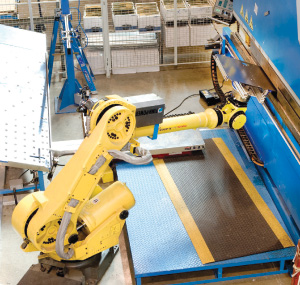 Day-Brite had a series of parts that required two operators to form a complete part. With the robotic press brake from Finn-Power, the company reports a labor savings of 40 percent of each part bent.
Unmanned Finn-Power FMS operation reduces scrap, increases profitability
Not long ago, Day-Brite Lighting of Tupelo, MS,
found itself at a crossroads. The company, founded in 1923, realized
its business had gradually moved away from just commodity products
to a more architectural grade product. It needed more productive
fabrication equipment, and it needed to curb the growing amount of
contract work the company turned over to local job shops and bring
it back in-house.
Today, the company has evolved into a major force
in the lighting industry with a facility that includes 350,000
square feet of manufacturing space, a 150,000-square-foot warehouse,
and 500 hourly employees.
"Day-Brite’s challenge was to find a way to go
from product design, to fabricating the part, and have it ready to
assemble within one day," explains Scott Bratton, fabrication
manager. "Our task was to find the best equipment to accomplish this
goal."
The search for a solution
"Basically, we shopped around the world looking
for new equipment," adds Charles Philips, director, manufacturing
and industrial engineering. "We wanted to change the direction of
how we manufactured our high-volume products at the Tupelo plant.
"We had to modernize. We had two aging turret
punch presses and 11 large stamping presses with progressive dies
for high-volume runs. The dies can cost up to $1 million and take up
to six months to produce. We had a new product line we wanted to
introduce — a high-bay fluorescent — before our competitors did. The
manufacturer who brings its products to market first has the
advantage. So we had to go quickly to market."
Several Day-Brite technical teams criss-crossed
the globe searching for the fabrication equipment. Bratton and Bob
Dexter, plant superintendent, visited Finn-Power’s facilities in
Finland.
"We saw many facilities where multiple machines
were running with just one operator," says Bratton. "We decided that
Finn-Power would fit the needs at Day-Brite."
Day-Brite phased in the Finn-Power flexible
manufacturing system (FMS). The system included the Shear Genius
punch/shear combination, a hydraulic press brake with robot, and six
bays of the Night Train material management system to tie it all
together.
Shear Genius flexibility
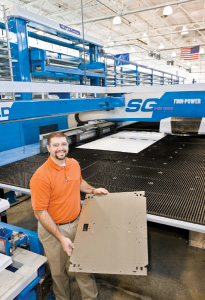 Scott Bratton, fabrication manager, reports that Day-Brite’s challenge was to find a way to go from product design, to fabricating the part, and have it ready to assemble within one day. The Finn-Power integrated system allowed the company to introduce the new product to the market for a total of $4-million in new product sales in 2005 alone.
With the Shear Genius concept, the objective is
to provide one machine capable of transforming a full-sized sheet
into punched parts. These parts can be moved to secondary
operations utilizing the sorting and stacking automation into the
Night Train material management system and on to bending operations
without being touched by human hands.
As loading, punching, and shearing of parts
become automated, the result is finished parts with a dramatic
reduction in scrap and manual labor while increasing profitability.
Shear Genius functions with simplicity, able to
perform demanding jobs with minimal setup times and "lights out"
operation. The Shear Genius increases material productivity through
nesting programs. The level of automation can be customized through
Finn-Power’s flexible modular solutions for raw material storage,
loading, unloading, sorting and stacking. These features can be
added later.
The Shear Genius ease of operation does not
compromise the cell’s per-minute part production, flexibility, or
ability to fabricate complex parts. On average, Shear Genius reduces
total manufacturing time by 60 percent and saves one blank sheet out
of every 10.
The Shear Genius eliminates secondary operations,
such as deburring. Nibble edges on the part exteriors were
eliminated through the use of the integrated right angle shear. In
fact, the same clamps that hold the sheet for punching also hold it
for shearing. In essence, the Shear Genius allows the automated
process to begin with a full-sized sheet of material and end with a
finished part after automated loading, punching, forming, shearing,
and unloading — all in one operation.
According to Bratton, the benefits of the Shear
Genius included reduced labor costs, shorter lead times, higher part
quality, and repeatability of that quality.
"On our older turret punch presses, the
consistency of quality was left in the hands of our operators," says
Bratton. "They would have to shear the blank to a certain size and
then load it into the turret punch press. With the Shear Genius,
we’ve eliminated blanking since we are able to fabricate full-sized
sheets and nest the parts, ensuring part consistency and squareness
from one run to the next."
Night Train system chugs right along
The centerpiece of the Finn-Power automated sheet
processing system is the Night Train Material Management System,
which is the inventory and
material transporting center.
The Night Train FMS provides a total solution for
unmanned operation for sheet metal fabricators by automating system
control, as well as material flow within the system. This includes
supplying raw material as well as removing and storing work in
process.
"The integration of the Night Train with its
management system was a big feature for us," says Dexter. "We run a
great deal of 24/7, including ‘lights out’ over the weekend on some
of our larger volume product to get a jump on production."
Robotic hydraulic press brakes
According to Bratton, the primary focus of the
robotic hydraulic press brake was to eliminate two-man operations on
the press brake.
"We didn’t care about keeping the robotic press
brake running 100 percent of the time," Bratton says. "Rather, we
had a series of parts that required two operators to form a complete
part. With the robot, every time we form and make that product, we
save about 40 percent … and that’s just labor. And I get a better
part. We run about 500 of the 2 x 4 size a month. Our total savings
is about 50 percent per part."
Other benefits of the robotic press brake
include:
- Unmanned bending at maximum speed
- Consistent parts
- Integration into Finn-Power’s Flexible Manufacturing System.
Day-Brite began production with a first shift.
Three months later, the company added the second shift, and two
months later it added the third shift.
"We average approximately 18 hours of machine
uptime," Dexter says.
"Finn-Power’s introduction at Day-Brite was a
huge success," says Bratton. "The Finn-Power integrated system
allowed us to introduce the new product to the market for a total of
$4 million in new product sales in the first year.
"While we hoped that the Shear Genius would allow
us to bring the contract work back inside, we weren’t able to
accomplish this at the time because the Finn-Power system was
running at full capacity within six months."
The second phase began 18 months later with the
addition of another Shear Genius cell, a Night Train extension of an
additional four bays, and two servo-electric E press brakes.
The new Shear Genius was the SG8 with a maximum
sheet size of 1,500mm x 4,300mm. With this addition, Day-Brite
brought back 75 percent of the fabrication that had been contracted
to local job shops. The remaining job shop contracts mainly include
laser cut parts.
"Our new Shear Genius runs nothing but
pre-painted metal, galvanized, and mirro aluminum," explains
Bratton. "From a customer standpoint it has helped us get products
to our customers faster. It has helped our design engineers with
product development.
"We dedicate our machines and no longer have to
contract outside parts. We program the part, form the part, and get
it to them so we can now take the product to market quickly. This
has given us a competitive edge.
"The E Series press brake is a phenomenal piece of equipment," says Bratton.
"Many of our products have multiple forming operations. With
the Finn-Power E Series press brake, we have seen increases in our productivity,
quality repeatability, and reduced setup and programming times. We estimate
savings of 35-40 percent bending with the new press brakes over the older
models."
"We have not had any significant downtime on the Finn-Power equipment," says
Dexter. "The installation of the equipment went very well. It was always on time
— and when we turned it on …it ran. Finn-Power did a very professional job
getting the equipment up and running as well as servicing and maintaining it."
Finn-Power
What do you think?
Will the information in this article increase efficiency or
save time, money, or effort? Let us know by e-mail from our
website at
www.ToolingandProduction.com or e-mail the editor at
dseeds@nelsonpub.com.