October 2008 Edition
fluid management
Like a ‘perfect storm’
Though oil prices have fallen, lubricant costs remain a heavy burden
By Peter B. Alpern, Associate Editor
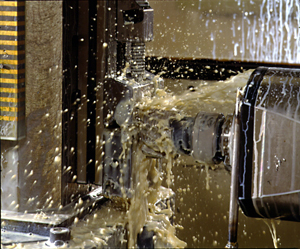 Material cost increases have forced lubricant manufacturers to raise their
prices.
Material cost increases have forced lubricant manufacturers to raise their
prices.
When oil prices surged in early summer, the increase sharply cut into the
profits of numerous American businesses, pushing many to raise prices and
maneuver aggressively to offset the growing cost of merchandise made from
petroleum.
Airlines, package shippers, and automobile owners were no longer the only
ones being squeezed by the ever-mounting price of oil, which hit a record high
of $147.27 a barrel on July 11. Though as of press time oil dropped by more than
a third of its price, there was no change in the domino effect from months
earlier. The high cost of petroleum-based products is touching every corner of
the industry.
Manufacturers of lubricants, which are made from base oil and various
additives, have watched their costs skyrocket, forcing them and their users into
unpleasant choices: Should they raise prices, shift to less costly procedures,
pass the costs onto customers, or all three?
Castrol Ltd., one of the world’s largest manufacturers of lubricants, for
instance, has adopted several programs to help refine customers’ lubrication
processes.
“We were already seeing upward price pressure throughout
the year. But in May, that’s when things started to go crazy.
Most of the suppliers out there saw their cost on base oil go up
over 80 cents to a dollar overnight.†— Shane Terry, president
of North American Lubricants
But moving toward efficiency isn’t enough. Castrol has raised prices on its
lubricants three times in the last year — and a fourth increase appears to be
imminent.
"We have to try to keep up with the cost increases we’ve incurred," says Tim
Allsup, Castrol segment manager. "We always try to absorb as much as we can, but
it gets to a point where you have to attach them along."
That increased cost has shifted downriver, hitting manufacturers
in nearly every facet of industry.
"The rise in petroleum-based products has pervaded everything,"
says Al Lubrano, president of Technical Materials Inc., a Lincoln,
R.I.-based manufacturer of specialty metal products for computers,
automobiles and telecommunications. "And now it’s impacted the price
of lubricants. There’s really nothing you can do about it. With all
of our equipment, you have to flood them with lubricants. We have no
choice."
A steady upswing
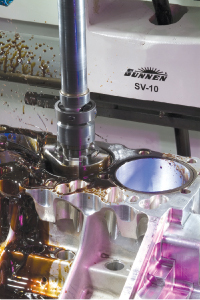 When oil prices shot past $135 per barrel, base oil producers canceled
pending purchase orders.
When oil prices shot past $135 per barrel, base oil producers canceled
pending purchase orders.
Like the price of oil over the last year, the cost for lubricants
has risen swiftly and by staggering proportions.
"The costs have basically doubled," says Gerry Letendre, CEO of
Diamond Casting and Machine Co., a component manufacturer in Hollis,
N.H. "You end up spending twice as much for the same amount of
product."
Material costs have risen across the board in the industrial
sector. Many increases were circumstantial, reflecting the weak U.S.
economy.
"What we’ve seen is a perfect storm of events," says Shane Terry,
president of North American Lubricants, a manufacturer of motor
oils, hydraulic oils, and transmission fluids.
Most suppliers enact pricing adjustments at the start of each
year. North American Lubricants pushed through a modest increase for
January. By the first weeks of summer, a series of circumstances
changed the face of the lubricant industry.
On May 21, oil prices shot past $135 per barrel. Base oil
producers responded by eliminating "spot purchases" — discounted oil
bought on high volume orders — and canceled pending purchase orders.
At that same time, as gasoline and diesel pushed toward historic
records, major oil refineries pulled back on the production of base
oil — further exacerbating the situation.
"We were already seeing upward price pressure throughout the
year," says Terry. "But in May, that’s when things started to go
crazy. Most of the suppliers out there saw their cost on base oil go
up over 80 cents to a dollar overnight."
Sunnen Products Co., which manufactures honing machines,
abrasives, and bore gages, including its own line of honing oils,
pushed through five price increases in June and July alone.
"We’ve had customers that come back to us and wonder why we’re
increasing our prices so high," says Sunnen product manager Mike
Murphy. "I say, ‘Have you been to the gas pump lately?’ "
But as oil prices have begun to ebb, that relief hasn’t
translated into price reductions for lubricants.
"The end consumer, meaning the industrial plants and
manufacturers, have not seen the full effect of these price
increases on their costs yet," says Terry. "Those are still being
passed onto customers. And they will probably continue to be passed
on, I would guess, through the end of the year.
"So we have a solid four or five months left of increases. There
are some major increases that are going to be hitting the market now
and in the near future. Watch out. These are increases the general
consumer has never seen before."
Maneuvering methods
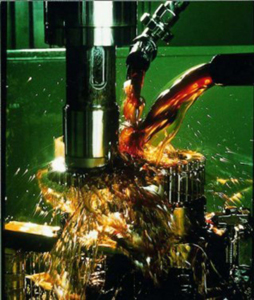 How lubricants are used is being viewed more seriously.
When the price of any product reaches an inflated rate, consumers
will ultimately create new ways to save elsewhere. Whether that comes
through driving trucks more fuel efficiently, heating a plant with
geothermal pumps, or turning off motors when they’re not running —
industry has begun thinking outside the box.
But lubricants present far more of a challenge because they’re so
specialized.
One of the most common temptations is to simply cut back on how
much and how frequently lubricants are applied. It is also one of
the most twisted and self-defeating forms of logic.
"If you skimp on maintenance and you try to cut back, you could
end up having to buy replacement parts or a whole new machine," says
Roger Sustar, president of Fredon Corp., a supplier of machined
parts, based in Mentor, OH. "And that’s a heck of a lot more
expensive."
Simply maximizing a maintenance schedule can pay immediate
dividends.
Total cost of ownership (TCO) is the methodology that Castrol has
adopted when selling value-added products and services. TCO is a
calculation designed to help customers understand and assess the
direct and indirect costs and benefits of the materials they
purchase. It includes the initial outlay of purchasing, such as the
unit price of products and the volume purchased, and any indirect
costs affected by product usage.
According to Castrol Product Manager Phil Ames, price is often
only a small portion of the TCO.
Lubricants, he estimates, account for about 3 percent of the
total maintenance cost of an operation. However, they have a much
greater impact on the overall maintenance and production budget due
to the value they create upstream and downstream.
So while the temptation might exist to purchase the lowest cost
lubricant and use it in higher quantities to get the required
lubrication, it ultimately might not be cost-effective. A more
expensive, specialized lubricant might cost more initially, but
could help raise production volume, reduce parts replacement cost,
labor cost, including environmental impact and wastewater strain.
"That’s one of the areas that we really work toward: digging
deeper into the total impacted cost of the lubricant and putting a
program together that can provide some substantial savings in either
cost or production increase," Ames says.
Whether it is through a formal program or through greater
systematic scrutiny, how lubricants are used is being viewed more
seriously.
"The days of the loosey-goosey service schedule are over," says
North American Lubricants’ Terry. "I’ve been to many, many
manufacturing plants where the maintenance manager’s rule of thumb
was viewing oil as cheap insurance. Those days are over. They need
to maximize their service intervals and their service program."
Cutting the coolant
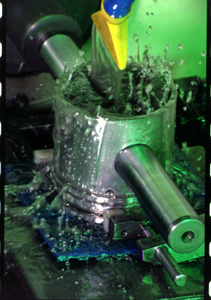 Although the price of gasoline has dropped in recent months, the costs for
lubricants remain high — and might not be coming down anytime soon.
Although the price of gasoline has dropped in recent months, the costs for
lubricants remain high — and might not be coming down anytime soon.
An increasing number of companies are finding that in the right
applications and cutting requirements, minimum quantity lubrication
(MQL) can be a cost-saving and environmentally friendly option.
Like lubricants, the cost of coolant continues to rise. In fact,
some estimates suggest coolants take up approximately 15 percent of
the lifecycle operational cost of a machining process, including the
costs associated with procurement, filtration, separation, disposal,
and record keeping for the EPA.
MQL, or near-dry lubrication, is the use of a minimal amount of
cutting fluid mixed with air as an aerosol to provide controlled
lubrication and reduce friction at the cutting-edge zone.
The process permits dramatic cuts in coolant costs, while
protecting workers and the environment. It also can provide improved
tool life and surface finish — even though tool life is often the
reason why wet machining is applied.
MQL machining has already been applied at Ford Motor Co.’s Van
Dyke Transmission Plant in Sterling Heights, MI. It provides a metal
removal process that is performed nearly dry — all without having to
invest in a costly cooling system.
"MQL is the best way of minimizing how much product you’re
actually using at the point of cut," says Castrol’s segment manager
Allsup.
There are other similar coolant technologies being bandied about,
he says, including the development of compatible chemistries — where
the coolants, hydraulic oils, and lubricant all work in combination.
"I think you’re going to see a product line in the near future
that’s from coolants, lubricants, and honing fluids that are all
compatible in one eco-friendly package," Allsup says. "That will
allow the user to not have to dump and run minimal maintenance. It’s
all based on certain individual components of the fluid."
A more expensive, specialized lubricant might cost more
initially, but could help raise production volume, reduce parts
replacement/labor costs, including environmental impact and
wastewater strain.
More in the present, many companies have turned to dry machining
as a means of production. One of the primary benefits is trading a
slightly shorter tool life for the chance to eliminate the cost and
headaches of maintaining cutting fluids.
Dry machining can be limited by application. For instance,
sometimes a cutting fluid can stain a workpiece or contaminate it.
Consider a medical implant, such as a ball joint for a hip. Fluids
are undesirable where there is the fear of contamination.
But a workpiece’s suitability for a dry process also depends on
the material. A cutting fluid can be completely unnecessary for
cutting most alloys of cast iron, and carbon and alloyed steel.
For a number of materials, dry machining is seldom an option.
High-temperature alloys make up an entire class of materials in need
of cutting fluids. Cutting in nickel- and chromium-based alloys in
particular produces extremely high temperatures that require fluid
to dissipate the heat. For machining titanium, cutting fluids are
mandatory.
Next generation
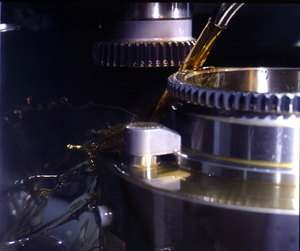 There are various ways to apply oils such as by flooding, spraying,
dripping, or misting.
There are various ways to apply oils such as by flooding, spraying,
dripping, or misting.
Lubricants made from vegetable oils, such as soybean, corn, canola,
and rapeseed, offer a safe, biodegradable alternative for many
applications. Researchers have been working on these bio-based products
since the 1980s, but they were long overlooked because they didn’t work
as well as petroleum-based products and, more importantly, were
exorbitantly more expensive.
But in recent years, technological advances have improved
bio-based lubricants, and with the increased rise of oil prices and
energy security needs, they have become more cost-competitive with
traditional petroleum products.
Lou Honary, founder of the University of Northern Iowa’s National
Ag-based Lubricants (NABL) Center, expects bio-based lubricants to
be in widespread use within a window of two years.
"The time has come that we’ll see more rapid growth for these,"
says Honary.
One company that has experimented and found great success with
bio-based lubricants is Alcoa, the world’s third-largest producer of
aluminum.
Earlier this year, Alcoa tested a soybean oil lubricant developed
by the U.S. Department of Agriculture’s Agricultural Research
Service (ARS). Used at its Reno, NV, aluminum rolling mill, Alcoa
found that the new lubricant worked better than the petroleum
product it had been using, according to Ronald Reich, a technical
consultant at Alcoa. The fluid cut costs and volatile organic
compound emissions by more than half.
Vegetable oils as lubricants are nothing new to the metalworking
industry. However, in previous efforts, the lubricants oxidized too
easily. The soy oil resisted oxidation because scientists reduced
the double bonds in the structure along with adding proper
antioxidants for stability.
Although the technology is advancing quickly, it still has a way
to go. Bio-based lubricants take up only a 5 percent share of the
market and remain inadequate for use in automotive, aircraft, and
heavy machinery industries.
"Typically, with most of your veggie-based lubes, you don’t get
the oxidation like you get from a crude derived mineral oil," says
Castrol’s product manager Ames. "The applications you can use them
for are somewhat limited. You make a sacrifice. But it’s something
that’s developing."
Part of the process
For better or for worse,
Kennametal relies heavily on having access to a steady stream of
lubricants. The metalcutting manufacturer uses LACH solvent for its
powder processing operation. It serves as a virtual lifeblood of the
ball milling process, preventing the material being ground from
coating the milling balls.
But the cost of that solvent has risen 61 percent in the last 15
months, including massive jumps in every month of summer.
Kennametal has little choice but to accept the times.
“We’ve had customers that come back to us and wonder why
we’re increasing our prices so high. I say, ‘Have you been to
the gas pump lately?’ †— Sunnen product manager Mike Murphy
"The escalating price is definitely a challenge to
manufacturing," says Joseph J. Penkunas, Kennametal manufacturing
manager. "As with any challenge, we must manage the impact through,
among other things, leveraging our global purchasing footprint when
possible, and through looking for ways to conserve the resource.
Because at the end of the day, these lubricants are necessary to the
manufacturing process and their cost is a fact of life right now."
It’s exactly the same boat nearly every manufacturer is in these
days. And while companies can do the little things — such as storing
lubricants in dry, clean areas and watching not to over-buy on
storage — the bigger picture boils down to one simple truth: the
price of lubricants might not be coming down soon.
One of the most common lines of thinking Sunnen product manager
Murphy has heard over the years is a lubricant is a lubricant — oil
is oil.
"A lot of times, people are perceiving lubricant only by its
price — they’re not looking at what it does for their machines or
how it factors into the cost per part," he says.
"The reality is, lubricant is part of the whole process. They say
there are nine parts to a process: the machine, the tooling, the
fixturing, and so on. Well, lubricant might be viewed as only No. 9
on that list. But it’s just as important as anything else."
Castrol Ltd.
U.S. Department of Agriculture Agricultural Research Service
North American Lubricants
Sunnen Products Co.
Kennametal
What do you think?
Will the information in this article increase efficiency or
save time, money, or effort? Let us know by e-mail from our website at
www.ToolingandProduction.com or e-mail the editor at
dseeds@nelsonpub.com.